KELLY AMTOWER
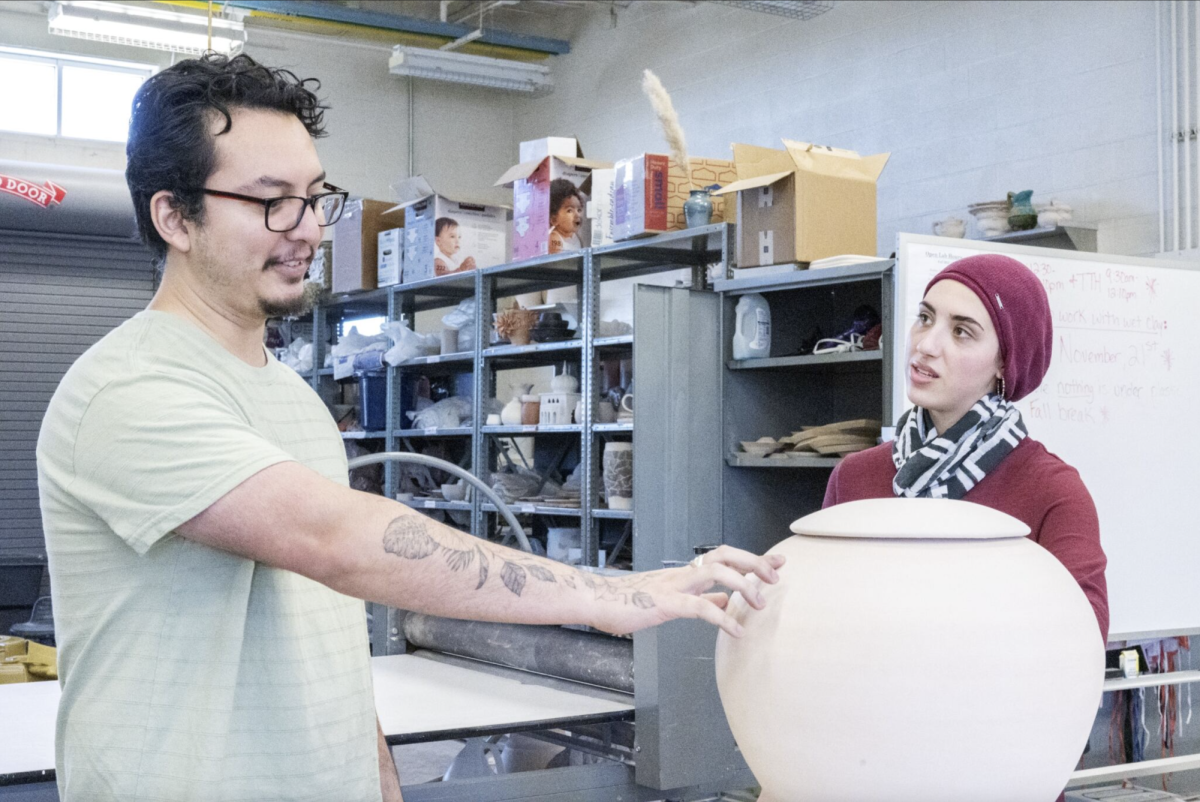
SE ceramics instructor and artist Juan Barroso explains his plan to paint images of immigrant laborers on his handmade vase to lab tech Huda Dorsett.
The young man wrung water from a mop bucket, sweat clinging to his shirt and brow as he pushed the soapy water across the tile floors. It was another late night working at Michaels, and Juan Barroso just wanted to go home.
Barroso recalled feeling embarrassed by the sign on the back of his mother’s van, which read “Lucy’s House Cleaning” in an eye-catching pink.
“I used to have her drop me off a block from the school to avoid people seeing that sign,” Barroso said. “It wasn’t until I started working and it was my job to mop the floors at night, that I realized the dignity of her work.”
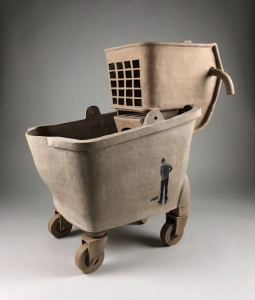
In his recent art exhibit on SE Campus, adjunct professor and award-winning artist Juan Barroso pays homage to his mother’s labor in the form of a stoneware mop bucket titled “Honoring the Janitor Mop Bucket.”
The sculpture is a smooth, textured brown bucket with four swivel wheels attached to the bottom.
Barroso said the sculpture worked, but it would squeak badly if used as an actual mop bucket.
While honoring his family is a core theme in his art, Barroso also emphasizes his heritage as the son of immigrants in sharing both the joys and struggles of the immigrant experience.
“Honoring Textile Labor”, a hand-painted porcelain vase featured at the exhibit, was inspired by Barroso’s mother and grandmother and the textiles they worked with in the past.
Barroso was born in Oklahoma City, but he spent some of his early childhood in the city of San Miguel de Allende, in Guanajuato, Mexico. They had moved to wait for confirmation of his mother’s residency status.
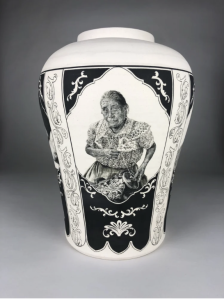
“We didn’t have a lot to eat,” Barroso said. “My mom would sew, repair and wash clothes to provide for us. I made this vase to honor textile labor and all the stitches my mom put in to provide for my sister and me.”
The vase displays multiple paintings on its sides. The painting positioned at the center is of Barroso’s grandmother cross-stitching a cloth. The other paintings on the vase are of several different textile tools and a mariachi violinist.
Barroso explained that the violinist had been one of the many musicians to escort his grandmother to her wedding vow renewals.
“They [my grandparents] were too poor to marry during daylight,” Barroso said. “Maybe a decade ago, they went back to marry, and at noon, the most expensive wedding time, my grandma was escorted by a mariachi group. It had shown how far the family had come since moving to the U.S.”
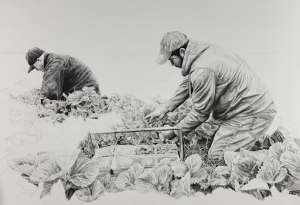
“Honoring the Farm Worker” is a graphite drawing depicting some Tennessee immigrant farm workers Barroso had spoken to. The drawing shows two men crouching in a softly drawn strawberry field, hands reaching for strawberries to pick and sort into a side basket.
“They told me they were trying to send money back to their families. They told me their knees were hurting, and their backs were hurting,” Barroso said. “They didn’t understand why people were saying they were criminals. All they did was work and try to recover from their aches and pains.”
Immigration is a topic close to Barroso’s heart, touching all of his art in some way.
“My work’s purpose is to humanize the immigrant, and I think some of you might understand why that’s really important right now,” Barroso told the audience at the opening reception of his exhibit.
According to a May survey by the KFF, formerly known as Kaiser Family Foundation, 41% of immigrants, both undocumented and legal residents, say they are worried about deportation. These concerns can harm immigrant communities, leading to mental and physical health issues.
“With the current political administration enforcing policies that dehumanize and force immigrants into the shadows, recognizing an immigrant’s humanity is vital,” Barroso says in his artist statement on his website. “Notions of us or them deteriorate, and it becomes clear that we are all working and fighting to provide a shelter and a decent meal for ourselves, and often a family.”
SE student Parmis Azambakhtiar said she really connected with Barroso’s work at the exhibit.
“I come from an immigrant family, and I’m an immigrant myself. It felt very heartwarming [seeing the exhibit]. I saw myself,” Azambakhtiar said.
Azambakhtiar works at the SE Campus as the assistant to the gallery coordinator, Penelope Bisbee.
She said she particularly connected with Barroso’s “Honoring the Janitor,” as her mother had worked hard to provide for her and her siblings when they immigrated from Iran to the U.S. in 2014.
“She worked at Walmart,” Azambakhtiar said. “I never really understood why, but I just felt a kind of shame.”
Azambakhtiar described a time her mother had been bedridden from overexerting herself, saying both her hands and feet were calloused.
“America has always shared this ‘American dream’ with everybody, but the reality is, if you are an immigrant, it is a lot harder to have a comfortable life,” she said.
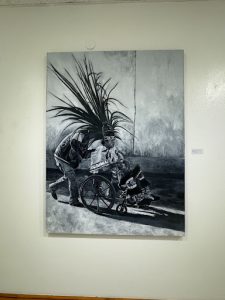
The largest piece of the exhibit is an oil painting titled “Resilience of Our People,” or “Aztec Dancer”.
Alongside painting and ceramics, Barroso also has a strong interest in photography. He attributes many of his paintings to photos he has taken.
The “Aztec Dancer” began as a picture Barroso took in the streets of San Miguel during the Drunken Donkey Parade, a Saint’s Day event. Barroso said that Saint’s Day celebrations used to include a donkey with a wagon carrying assorted drinks through the streets, often followed by a line of Aztec dancers.
One particular Aztec dancer caught Barroso’s eye.
“He seemed pretty resilient to me to still be dancing, even though he was in a wheelchair,” Barroso said.
Barroso said his journey with art had started when he was a kid as an “act of spite.”
In elementary school, Barroso had an opportunity to skip a grade with an art project. The project was drawing a detailed car. Barroso felt as if his rendition of a car wasn’t enough.
“So, I cried to my mom. She took me to City Hall and put me into a class with five giant high schoolers. There, I learned how to draw a one-point perspective,” Barroso said. “Early on in the City Hall in Mexico and then in high school, I was drawing hands holding flowers for my girlfriend every time we got into a fight.”
Now, art has become so much more to him.
One of Barroso’s painting techniques, as shown in “Honoring Textile Labor” and “Aztec Dancer,” is pointillism. Pointillism is the art technique of placing tiny dots near each other to form an image.
Barroso said he chose this technique because of its “time-consuming and labor-intensive process.”
“The process becomes an act of devotion. I cannot think of a better way to show my respect and admiration for my people and their will to survive than with labor of love and time invested,” Barroso says in his artist statement.
Concerns of censorship were raised during the reception.
SE student Katelyn Quenichet expressed surprise that the exhibit had been put on display on campus. Her concerns centered around the censorship of anything considered DEI related on college campuses.
“The reason why people need to share their culture is because there are cultures right now that are actively being erased,” Quenichet said. “And the only reason they haven’t just faded into obscurity as a collective people is because of things like this.”