KELLY AMTOWER
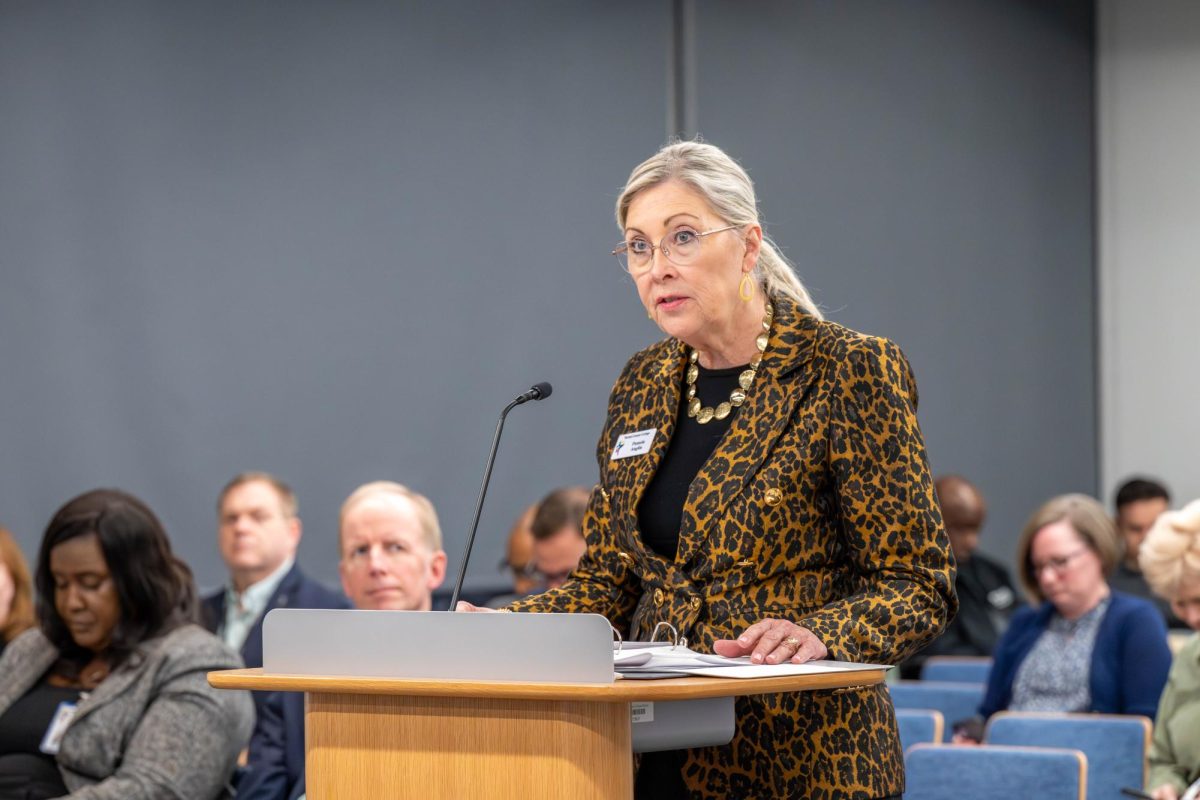
Chief Financial Officer Pamela Anglin presents at the Board of Trustee meeting Jan. 22.
The Board of Trustees approved a measure at its Jan. 22 meeting that would consider adding student fees, phasing out programs and modifying the college’s revenue sources to align its 2026-27 budget to the current economic situation.
“We’re being very frugal and conservative,” Chancellor Elva LeBlanc said. “At the same time that we will be bringing in new programs, we will be sunsetting those that are obsolete at this time.”
In February, the administration will have an updated summary to all the ways the college has been financially impacted and will address all the introduced considerations to offset costs.
“An update, or lack of a better word, reality check,” LeBlanc said. “We do have a new reality, and we are looking at every program, all areas of the college, and making sure that we have the resources where they are needed.”
In November 2024, Gov. Greg Abbott ordered colleges and universities to pause the increase of their tuition through 2027. This along with both the Tax Appraisal District freezing property tax appraisals, and different constitutional amendments and legislative actions increasing tax exemptions, has decreased the amount the college receives in revenue, according to Chief Financial Officer Pamela Anglin.
“We have a committee that is looking at, very broad based, any possible sources of revenue that other community colleges have, that we may have been not utilizing,” Anglin said.
The college will continue its zero-based budgeting strategy implemented in the 2025-26 fiscal year, where any spending requested must be explained and justified to the administration.
“It does require some transformational change for all of us in many areas,” LeBlanc said.
Board Member Veronica Law questioned the introduction of student fees being a part of their strategic budgeting plan and if the college was looking for other opportunities to increase revenue. Angling said it would be a part of their update in February.
“The category strategic budgeting is a broad term, but it speaks to all the transformational changes that we are experiencing,” LeBlanc said. “We’re making decisions about programs, aligned with their performance outcomes.”
Gwendolyn Morrison, a board member since 1976, asked Anglin to explain how their budgeting committee was approaching the introduction of student fees at the workshop meeting on Jan. 15.
“They’ve looked at what other colleges charge. They have looked at areas where we are paying for things that typically are charged directly to students,” Angling said. “They’ve also been very concerned about gradually kind of working them into it.”
On Jan. 22, Morrison still raised caution about their proposed considerations to cut certain programs, asking the college to be proactive in informing the community before introducing them.
“I would just ask that you make a special effort to include that population as an integral part early on, not reactionary to the cuts they may hear about,” Morrison said. “So, they speak in the process.”