KELLY AMTOWER
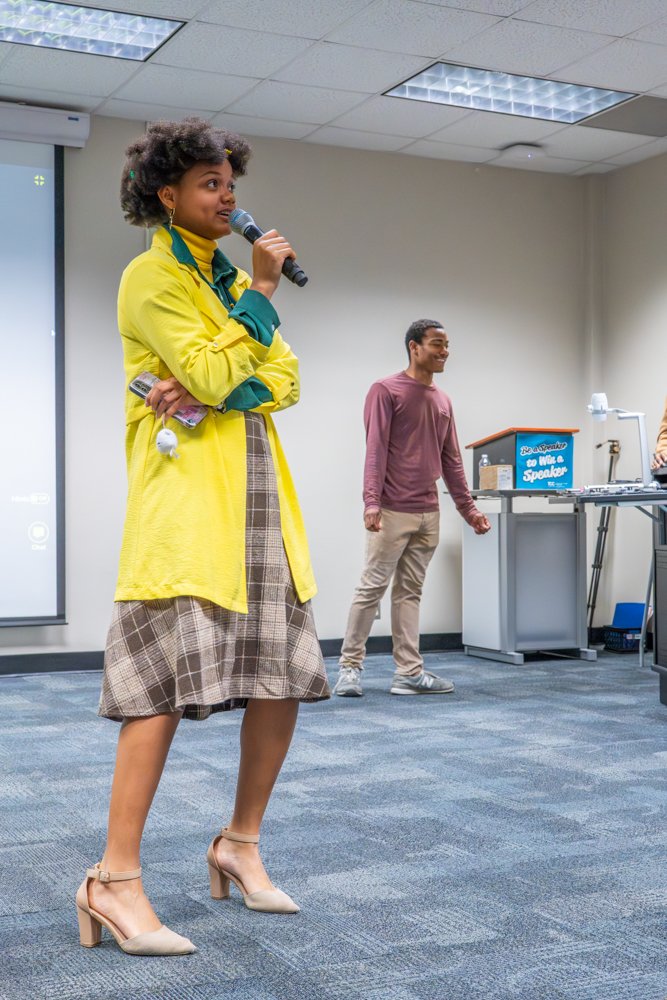
South student Monae Terrell emcees jeopardy night with Galvin Leberitt.
Students gathered on South Campus to celebrate the 100th anniversary of Black History Month with a night full of laughter, competition and community.
The Black Student Union organized a fierce game of Jeopardy with three teams competing to answer Black history trivia.
Teams shouted at each other across the room. Every table was decorated in shades of black, red and green. These colors, which originated from the Pan-African movement, symbolize the fight for liberation, renewal and richness of culture.
The BSU vice president, Monae Terrell, was the colorfully dressed game show host, clapping when a team guessed correctly and playfully teasing when they did not.
Terrell said she hoped that everyone there was inspired to dig deeper into Black history.
This event focused on both learning black history in a fun, interactive way and simply spending time together.
“We’re always trying to reach out. We have meetings like this every week. It’s either game nights or controversial topics,” said Curtis Taylor, former BSU president. “We try to do what we can to stand within the rules of everything. … I mean, there’d be so much more we can do if I had more leeway, or if there weren’t so many rules.”
BSU is one of many student organizations across Texas that are feeling the weight of SB-17 restrictions.
The Texas law outlines several restrictions on higher education regarding diversity, equity and inclusion initiatives. Student organizations and clubs are permitted cultural events and celebrations but without support from the college or its faculty.
“I think when it first came out, whatever it seemed like, it kind of put off everybody else, like they didn’t want to join, but they feel like they couldn’t join anymore because they were restricted,” Taylor said about SB-17. “‘Well, y’all can’t get people to join or be part of the leadership. This can’t be a thing. These, like, safe spaces? Get rid of them.’ But we push through. We all came together as not just the BSU, but OLAS (Organization of Latin American Students) and everything. Like, we’re all stuck together.”
Black History Month which was originally “Negro History Week,” was an unofficial recognition of the long-overlooked history of Black Americans created by the Black historian Carter G. Woodson in 1926. It officially became Black History Month in 1976, when President Gerald Ford recognized it.
Taylor said it is important to not only know how this celebration of Black Americans began but what impact it has on Black Americans today.
“Black History Month means to me, basically the history of our people, that we’re not forgotten, and accomplishments that we have taken, and sacrifices our people have made just for us to get where we are today,” Taylor said. “And it’s our job to teach, to not only learn but to teach those ones, I mean that’s our children. And that the history continues, like, you can accomplish anything you put your mind to. You are somebody.”
He said he wished Black history wasn’t reduced to one month, especially when a lot of it isn’t taught in schools.
One of the Jeopardy questions was “Who founded the Black Lives Matter movement alongside two other organizers?”
“When I was in the military, they had pulled us all aside and it was like, ‘If you join Black Lives Matter’, you’ll be subject to the full penalty of the law because they’re classified as a terrorist group,” Taylor said.
One of the BSU members, Adrian Jackson, said he never knew Booker T. Washington was the founder of Tuskegee University until the event.
Despite the roadblocks, BSU members are still doing the work of building community and giving opportunities to students.
The BSU plans on volunteering for a Historically Black College and University Expo that will be held Feb. 28 from 11 a.m. to 2 p.m. in the SSTU Dining Hall. The expo connects students with HBCU alumni and recruiters along with providing scholarship and transfer information.
“The overall goal is just making sure we leave our mark on this campus because I know some of the other campuses don’t have as much leeway as the South Campus,” Terrell said. “Since some of us are graduating, some of us are leaving, we want to make sure that we have a legacy to continue, so that more people can come in and more people can know about it. It’s not just another club.”