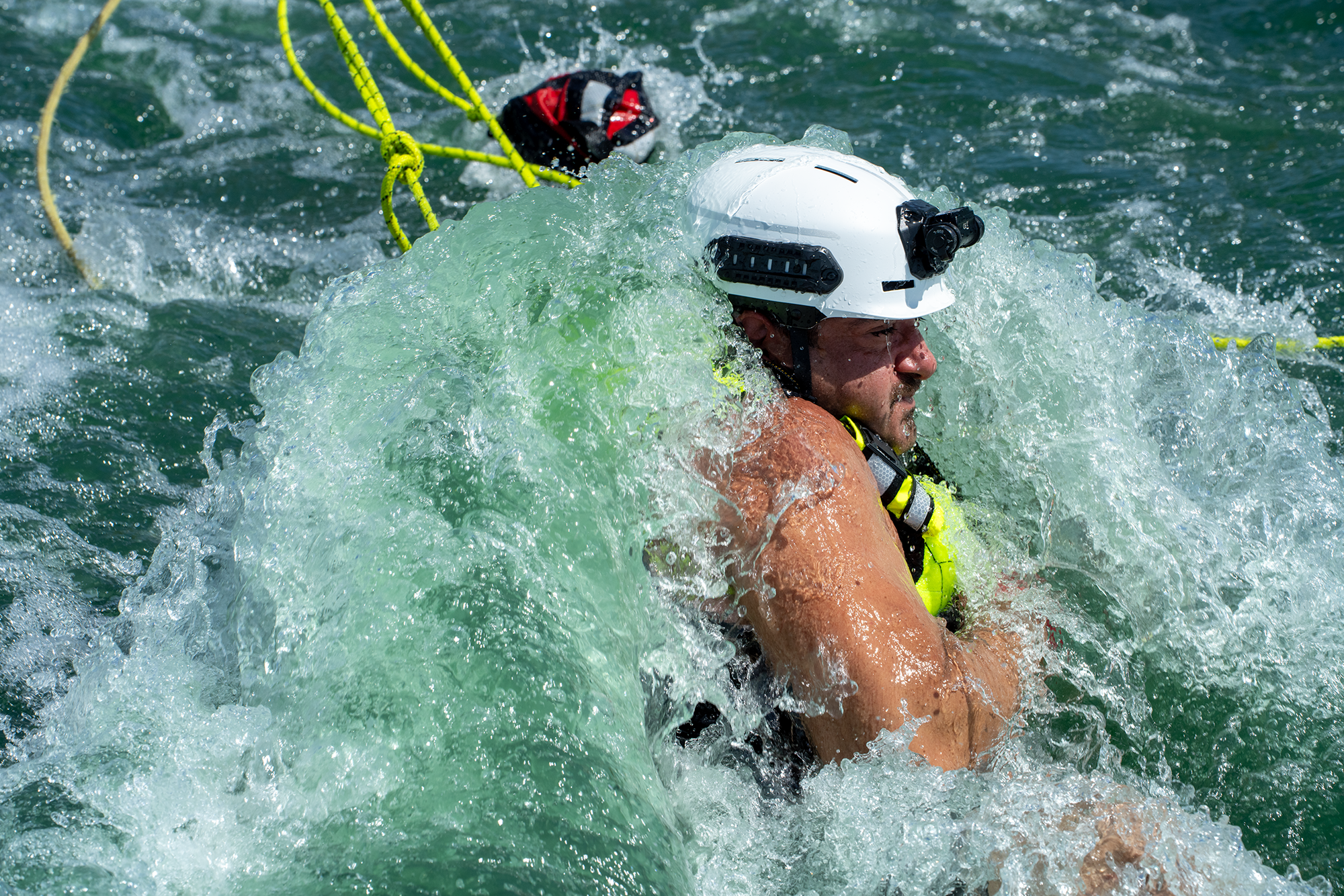

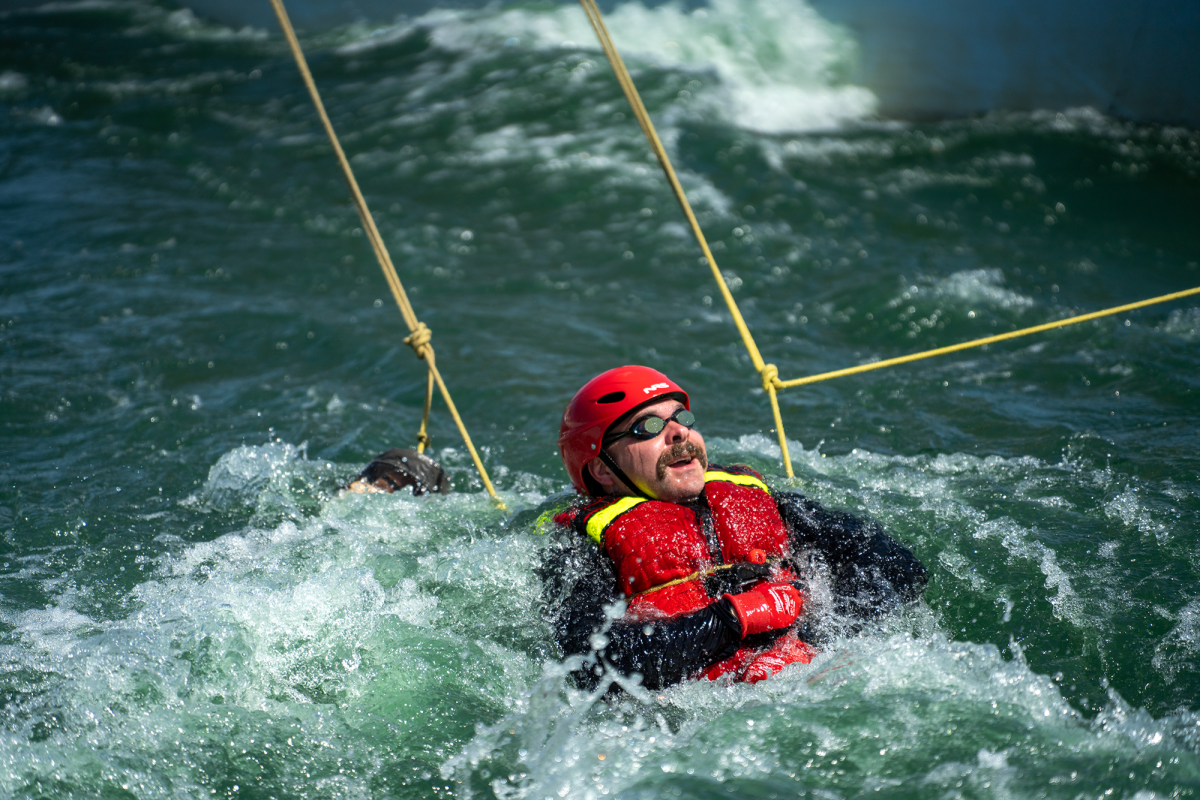
Under the hot, glistening sun, a group of firefighters from all over the country gathered by a rushing river. They whistled and hollered, throwing ropes across the water and swimming against the current.
This wasn’t an emergency. This was training.
The Swiftwater Rescue training class on NW Campus is a four-day certification class, which utilizes one of the only water rescue exercise courses in the country.
The structure, which pulls water from Marine Creek Lake, allows these active-duty firefighters to train for emergencies like flash flooding.
“The first thing we train them to do is to save themselves,” said Keith Copeman, a NW adjunct instructor and retired Arlington firefighter. “If you fall in the water, how are you going to get yourself out?”
Water rushes down the narrow funnel at the top and pours into a wider, larger river. It ends at a small waterfall, which runs into the man-made pond where trainees undergo rescue exercises with boats and canoes.
“It’s like a waterpark for adrenaline junkies,” said Leslie Cantrell, a firefighter from Carlsbad, New Mexico.
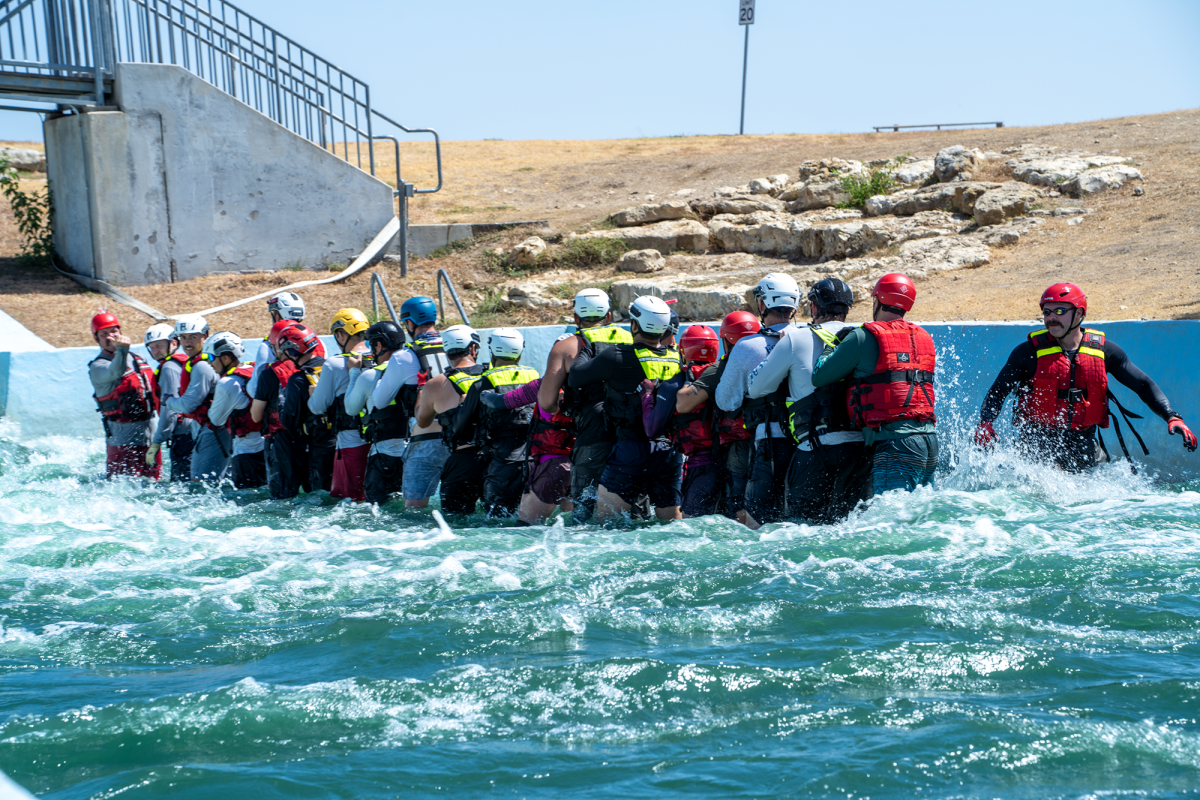
The Swiftwater Rescue training itinerary includes swimming assessment, rope-rescue techniques, partially submerged car extractions and boat rescues.
On Sept. 15, the second training day, the class practiced acclimating to the current and using ropes to rescue themselves and others from the water.
“It’s all about adjusting the scenario to what you see and being able to think outside the box on how to adapt what you’ve learned to fit the scenario you’re fighting,” fire training instructor John Johnson said.
The current reaches 12 mph at its full force, which is around 760 cubic feet per second of water, Johnson said. He then compared that to the speed of the 2025 flooding in Kerrville, Texas.
“In Kerrville, the water at its peak was flowing around 950,000 cubic feet per second,” he said. “So we’re just getting a little taste of what that actual water will be.”
One trainee, Chris Meszler, swam against the current, throwing his arm out to grasp an overhanging rope at the last second, just like his classmates who faced the same challenge.
However, unlike the others, Meszler is not a firefighter by trade.
He works as an engineer in an office most days, but he is also an on-call structural specialist with Texas Task Force One, a rescue team overseen by the Federal Emergency Management Agency.

“We specialize in partially collapsed structures to help our rescuers go in and find victims and shore the buildings,” he said. “Most of the team is built with firefighters, EMT paramedics — so we are a small resource on the team that kind of brings our expertise in the larger structural world.”
Meszler said he was sent by his team so he could gain water rescue experience and use his new knowledge to improve teamwork in the field.
“I can help out the rescue crews when they’re going out, or if for any reason I’m in or around the water, I can be a effective part of the team,” he said. “Make sure that I keep myself and others out of trouble.”
After learning to save themselves, the trainees practiced pulling weak or unconscious victims, who were represented by trainee volunteers during the exercise.
Copeman said he and the other instructors have the trainees play the part of the victim during these exercises so they can better understand and empathize with the victims they encounter in the field.
“You got to be the calm in the storm,” he said.
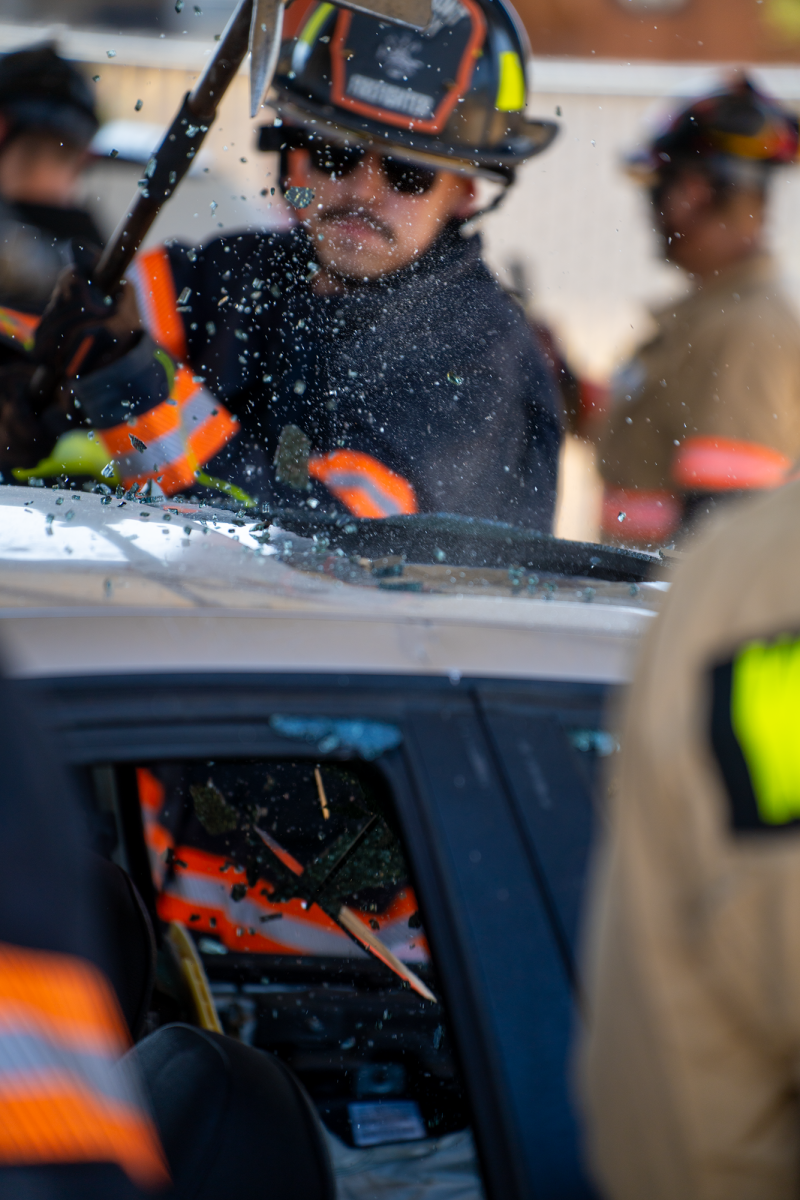
At the same time across the facility grounds, sparks flew and glass shattered as firefighters smashed through windshields and cut through metal.
This was the car rescue portion of extrication training, which focuses on rescuing people from small spaces or physical entanglement. These trainees learn to methodically pull apart the car to reach the victims without causing more injury.
Firefighters face some brutal and heartbreaking situations in the field. Copeman said that they either process these situations with “gallows humor” or jump to respond to the next crisis.
“The profession has a lot of challenges where it forces you to face yourself,” Cantrell said. “Things that people would typically be afraid of, you have to learn how to get over that in order to be the rescue.”
The firefighting culture is shifting when it comes to mental health support, according to Copeman.
“It’s slow to change, but it’s changing,” he said. “The process is changing the mindset that there’s nothing wrong with you, or that you’re not any weaker by saying ‘Yeah, that affected me.’”
Extrication and Swiftwater rescue are only two of the many different technical courses offered at the center.
Disaster-management, structural collapse, wildland firefighting, air rescue operations and chainsaw handling courses are all available to certified firefighters who are continuing their education.
“I just had to run the stats the other day for a report. We train about five hundred guys just in Swiftwater a year,” Copeman said.
Fort Worth firefighter and Texas Task Force member Brian Ray said he was excited to take the course because he is regularly stationed by the Trinity River, so his department is familiar with submerged cars and stranded swimmers.
Ray was introduced to fire service by his father-in-law nearly two decades ago. He specializes in urban rescue, which includes extrication. He has been in the service ever since because he has a mission that pushes him through the hard parts of the job.
“Same thing that got me on the fire department, and the same thing that led me to apply with Texas Task Force One is if that’s me in that hole or my family in that hole, I want somebody that’s dedicated, trained, competent going after them,” Ray said. “And for me to expect that, I have to be the person that’s willing to do that for somebody else.”