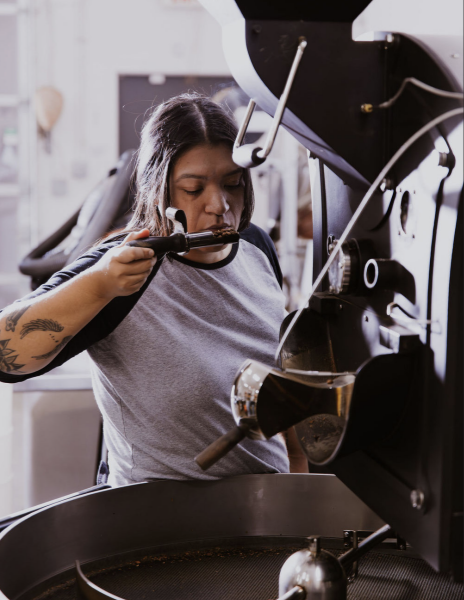
The unwavering hum of the roaster fills the warehouse as TCC alumnus Marisa Zapata watches the beans go from a pale green to a dark brown.
The aroma punches the air inside of Novel Coffee Roasters in west Fort Worth. As head roaster, Zapata works behind the scenes that most don’t see.
Zapata now stands at the heart of production, not only overseeing every roast but also redefining what an industry can look like where women are often underrepresented. Being a barista was her first step into the coffee industry. What was supposed to be a temporary job while finishing school soon became a newfound passion.
“I got hired at the same time as two other guys. And both of them got promoted as shift leads, then eventually managers and I was still just a barista,” Zapata said. “Advocating for myself in that and trying to get better pay was difficult.”
Every Wednesday, Novel Roasters delivers its freshly roasted beans to Cherry Coffee Shop in the Near Southside area of Fort Worth.
Sarah Amberger, TCC alumnus and cafe director of Cherry Coffee, ensures that every bag is accounted for. She quickly became cafe director at the beginning of her coffee career, which came as a shock since she was only 20 years old.
“It’s important to trust yourself and know you are in a leadership position for a reason,” Amberger said. “I think inclusivity is born out of understanding.”
The coffee industry can be an intimidating place for new baristas who all have to learn how to be diligent and efficient while also creating the perfect drink for every person ordering.
Danny Bellamy-Flores, a new barista at Cherry Coffee and TCC alumnus, has been learning the ropes of the coffee world.
“I wasn’t aware of the complexities that went into making coffee,” Bellamy-Flores said. “I grew up around coffee always being brewed, never the fancy stuff.”
Cherry Coffee and Novel Rosters are both owned and operated by Katherine Morris. She mentioned in an interview that there are only three female-owned coffee roasters in the Dallas-Fort Worth area.
“Last year, me and Katherine went to Mexico,” Zapata said. “I’d been to Mexico twice a year, every year growing up. But this was the first time I’d been to a coffee farm.”
Many people are not aware that coffee beans are grown and picked by hand. Seventy percent of labor in coffee production is provided by women, according to the International Coffee Organization.
“This was the first time I looked around and was like, ‘These are my people,’” Zapata said. “I felt very moved and was like ‘OK, how do I bring more of my culture and my voice into the thing I’m doing?’”
Zapata, shortly after that trip, began to bring awareness of what women endure in most coffee-growing nations.
She shared that 80% of women diagnosed with cervical cancer live in coffee-growing countries. This is due to the lengths many of these women have to walk to even be tested.
Grounds for Health also believes that women deserve more. This nonprofit has raised funds to make cervical cancer screenings more accessible for all women in coffee-growing nations.
Zapata continues to share her love and knowledge of coffee with those around her. She also ensures to speak up for the women who don’t have the same abilities.
“I have to tell myself, all I can do is make the impact that I can with the work that I do,” Zapata said. “Try to put my voice into things where I can and bring awareness to what’s happening in coffee-growing countries.”