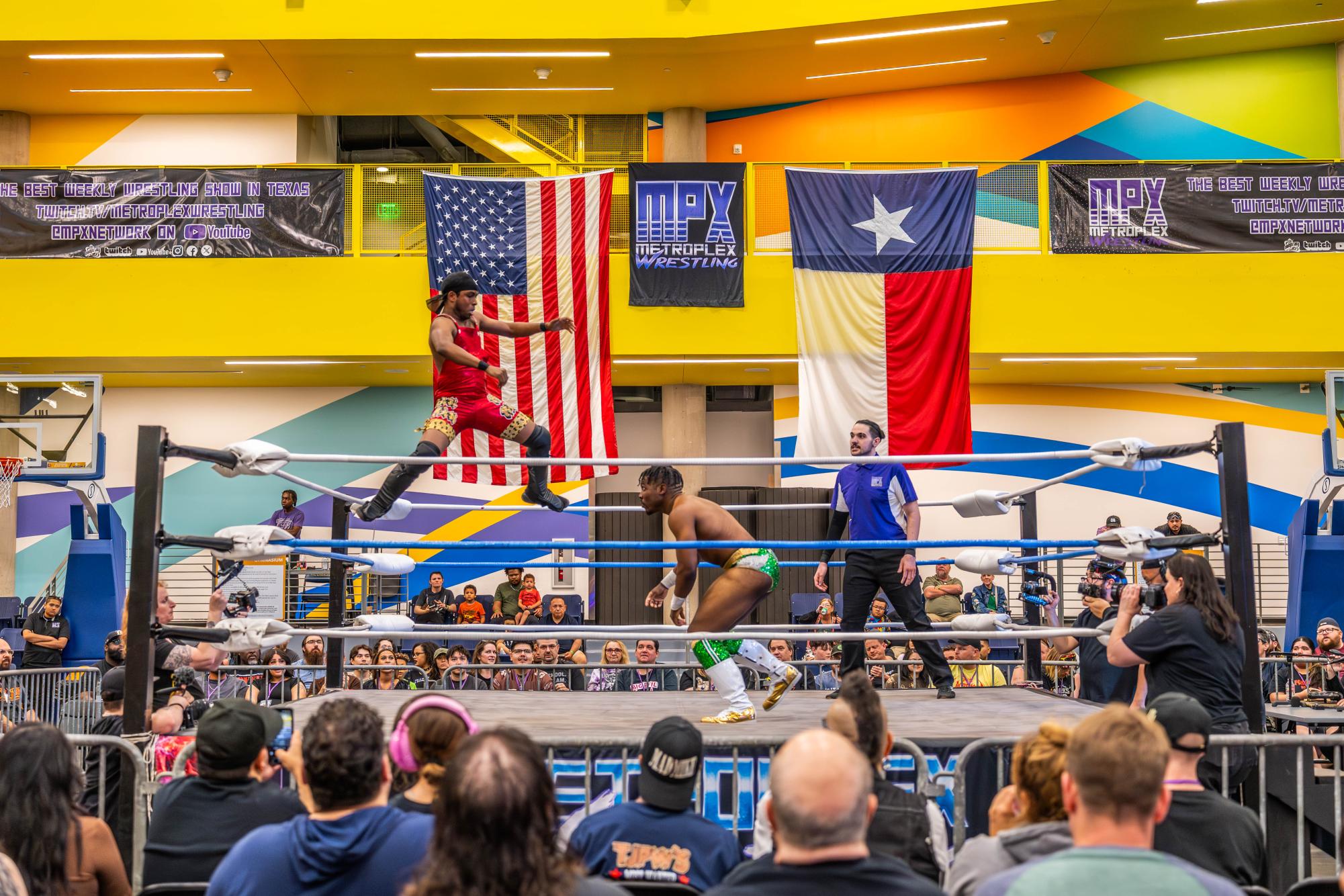

While fans cheer on a wrestler as he prepares to jump off the top rope to drop onto his opponent, Kennedy Hopkins and Bazz Turner are running around backstage.
Wrestling, a sport relying on theatrics, requires a production team. While the group works similar to those found behind the scenes at a musical, these individuals handle a lot more blood.
“Wrestlers are theater kids that just liked the violent part of theater,” said Turner.
He and Hopkins are both NE Campus students who can be found learning different camera, lighting and gaffing techniques in the Radio, TV and Film department during the week.
On weekend nights, though, they put their production studies to the test for Metroplex Wrestling, an independent wrestling organization based in Bedford. While there, they said they sharpen tech skills by implementing what they learn into real-world situations.
“That’s kind of why I’m getting my film degree here,” Hopkins said. “So that maybe I can be an editor for AEW [All Elite Wrestling] or do lighting or be a gaffer, just to somehow be a part of wrestling.”
Both have a unique love for the sport. However, their desire to stage dive knee-first into someone began at different times.
Wrestling injuries change their focus
Turner knew he wanted to be a wrestler by the time he was 9. So, his parents weren’t surprised when he started searching for wrestling schools after graduating high school, and his father introduced him to MPX Wrestling.
“A lot of wrestling schools around me were 30 minutes out, and I’m not driving 30 minutes to get beat up,” Turner said. “My dad found it one day because there was an ad at a comic shop, and he was like, ‘Try this.’”
He reached out to the organization, and they told him to come in for training. Turner’s childhood dream was finally becoming his reality.
But in just two weeks, his wrestling career ended.
“My spleen almost exploded,” Turner said. “Throwing yourself on the floor 80 times repeatedly, apparently isn’t healthy for you. Who knew? So, my spleen was like, ‘I’m gonna fill up with blood and become a water balloon now.’”
However, if it weren’t for his injury, he wouldn’t have turned his wrestling journey into a production tech one. While the pivot in his life was unexpected, it’s not unusual for a wrestler to suffer an injury causing their career to shift focus.
“I had a full humeral fracture and had to get surgery. I had a plate right here and the 11 screws,” Hopkins said while pointing to their right arm. “That was probably the most pain I’ve ever been in.”
While training in 2023, Hopkins said there was miscommunication with another wrestler which led to their arm being in the wrong place at the wrong time.
“I ended up colliding really hard with someone, and my arm was like this,” Hopkins said with their right arm at a 90-degree angle situated slightly in front of their chest. “I glided with them and my arm went bye. Worst pain ever, but yeah, I’ll do it again.”
Hopkins lost movement in their hand because of their injury. The intense nerve pains had made it difficult to regain strength.
Instead of succumbing to their brutal defeat, Hopkins found a way to stay part of the wrestling community. Friends at MPX informed management about their injury and got Hopkins a ring announcing gig, which led to becoming a backstage interviewer.
“I’m not actually a journalist,” Hopkins said. “In wrestling, your job is to make the other person look good, and that’s not just the wrestlers. … When I’m interviewing people, I try to make myself look smaller so they look bigger.”
What they do at MPX Wrestling
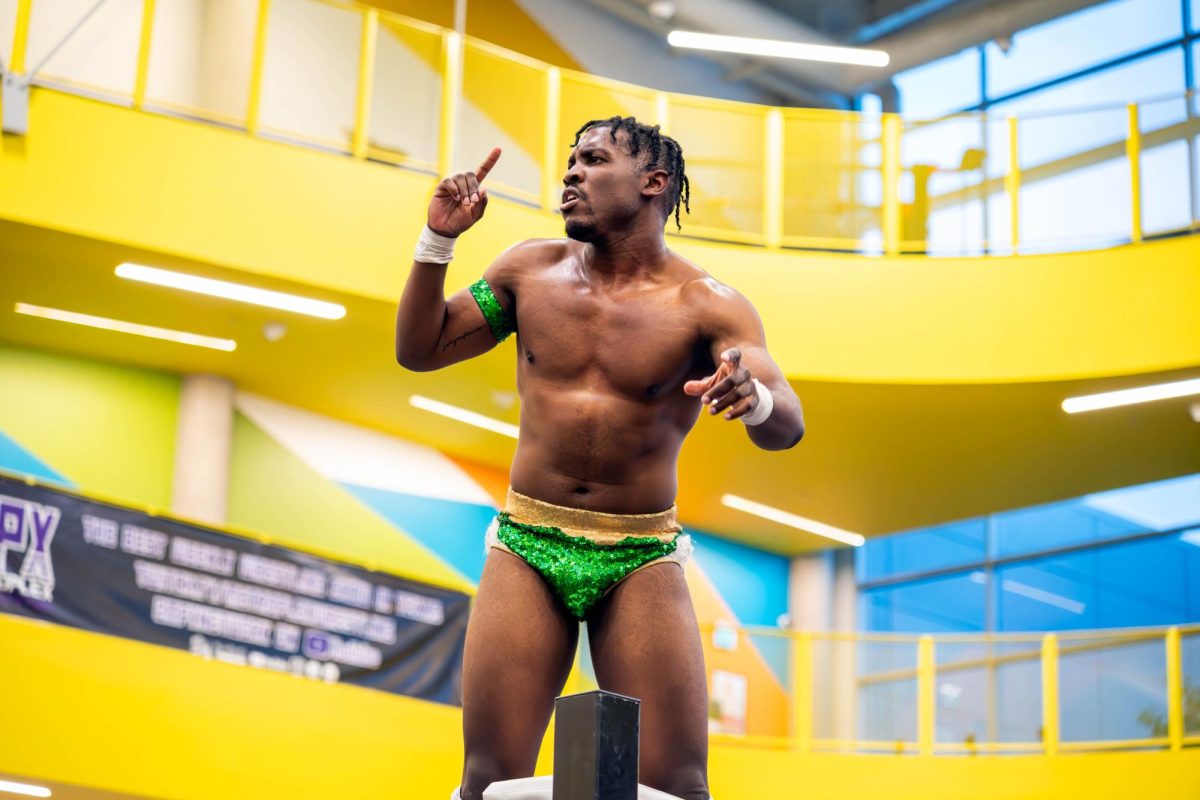
Both Hopkins and Turner play important roles during a match, just on different sides of the ring. While Hopkins announces and interviews wrestlers to pump up the crowd, Turner stands behind the camera to record matches and interviews that engage Twitch streamers.
Even though they’re part of production, what happens onstage is just as much of a shock to them as it is the audience.
“Whatever is posted on social media is all I know, most of the time,” Turner said. “Unless I absolutely have to know something, I try not to. I still crave the same thing the crowd craves.”
The match storyline, surprise moves and key moments aren’t shared with either of them, and Turner said he believes this makes him a better camera man.
“If you see a camera guy at a show and he’s already bracing for something, it kind of gives it away,” Turner said. “It’s one of those small things that kind of helps keep things natural. It makes it feel like a bigger surprise.”
Even as an announcer in the ring, Hopkins said their knowledge is limited.
“I’ve had moments where I thought one of my friends was legitimately injured,” Hopkins said. “I’m like ‘Oh my gosh, no.’ And then turns out they’re not actually hurt.”
In the RTVF classes on campus, it’s not part of their curriculum to learn how to brace backflipping in the air while manning a camera. But many of the skills taught in the classroom have helped them.
Turner said he has to do a lot on the fly during a show.
“This past woman’s show, we had a wireless camera and for some reason one of the receivers died. It just decided, ‘I’m not gonna work today,’” Turner said.
Only 10 minutes before the show was supposed to start, he had to run to Best Buy to purchase an HDMI cord.
“I had to find the longest cord I could buy. Bought it, ran back and then essentially ran that cord straight from the production switch all the way to the ring,” Turner said. “It gave the camera person about 20 feet of slack, and the whole time I was just praying the cord wouldn’t take anything with it.”
One of his favorite memories is when he had to go dumpster diving.
“This wrestler, he would bring an axe into the ring,” Turner said. “This match, it was one of those more hardcore matches where we used weapons. So, there were doors and all sorts of things all over the ring.”
After the show, Turner tossed everything into the dumpster.
“We come back and the wrestler was like, ‘I’m missing my axe,’” Turner said. “We had to go diving for his axe in a dumpster full of broken glass, tables and other sharp objects.”
Hopkins goes inside the ring during a match and uses the different techniques they learned in theater and wrestling training. They still get to perform with the wrestling community by announcing them as they enter the ring.
“If they’re a real badass wrestler, I’ll make my voice growl, and I really emphasize their moniker,” Hopkins said. “Or when they’re a good guy, I’m light.”
Recently, Hopkins began integrating yoga back into their routine to help rebuild the muscles they lost. One day, they hope to be back inside the ring, even though they’ll never forget the pain from their injury.
“One thing about wrestling is everyone’s a little bit crazy. There’s not a single sane person there because you have to get hurt,” Hopkins said. “You have to see the person across the ring and think, ‘I trust you to hurt me, but not that much.’”
Wrestling is improv
An hour before the April 11 MPX Destiny match began, Turner was setting up cameras while Hopkins raced to get ready for an impromptu appearance in the ring.
“I had nothing planned for that night. I was just gonna show up and hang out,” Hopkins said. “An hour before they just called and said, ‘Hey, I’m gonna have you do something,’ and even with that we had to improvise.’”
Many stories, Hopkins said, are made just hours before the show begins. The stunts wrestlers perform are typically improvised and not practiced together. In training, wrestlers learn to perfect their moves and how to take a hit.
The goal is to get it down perfectly, so once in the ring there is no room for error, Hopkins said. Once inside, wrestlers communicate through eye contact and different signals to tell each other what they’re going to do.
“It’s a lot of trust. You have to stay calm in the ring because if you freak out, then shit is going to go wrong,” Hopkins said. “You hear, ‘do this,’ and as soon as you hear it being said, you do it. So, there is a lot of trust.”
Lights, camera, wrestle
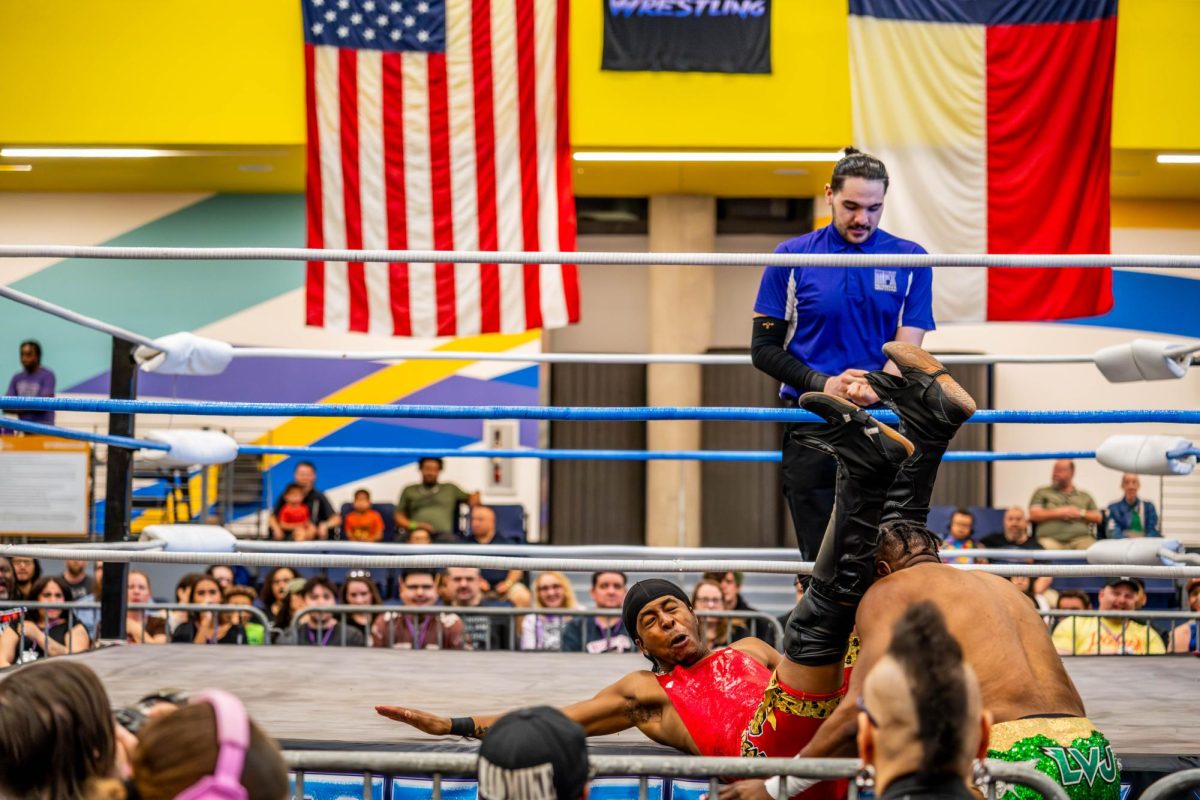
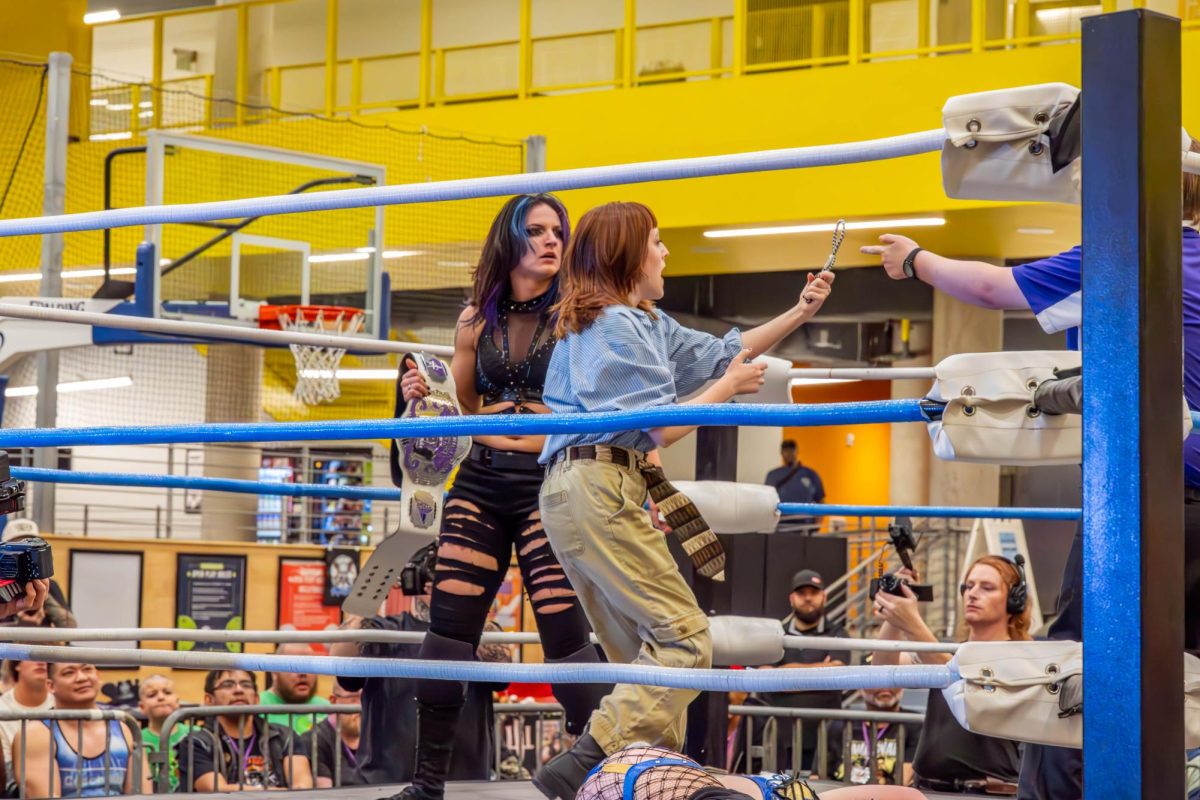
In the MPX American Joshi title match, former champion Anarkid Ash went up against Vert Vixen.
When Vixen’s name was announced, the crowd booed. Her unsettling mean mug and middle finger in the air had no effect on fans telling her she was going to lose.
Then Ash was called into the ring, and the crowd’s demeanor immediately changed. As she smiled and jumped over the rope with her champion belt in hand, everyone cheered.
Soon, elbows and fists were thrown. The two even performed a Frankensteiner, where Ash wrapped her legs around Vixen’s neck as Vixen sat on the top rope, and Ash used her body weight to flip them both into the ring.
“Vixen kind of flipped out and was beating down on Ash,” Hopkins said. “I was watching on screen and I was like, ‘Oh, crap.’”
Vixen pulled out a pair of brass knuckles and slammed them into Ash’s face, but the referee didn’t see. Ash laid unconscious under Vixen as he counted to three and mistakenly called Vixen the new champion.
Hopkins rushed into the ring and grabbed Vixen’s weapon from her pocket while she held the campion belt. After uncovering the truth, in an act of rage, Hopkins punched Vixen in the face and the crowd went crazy. Hopkins ran away, Vixen went down, Ash hopped on top of her and the referee counted to three naming Ash the champion.
Kaitlyn Norman, one of the few who cheering for Vixen, has been an MPX wrestling fan for a while now and has been learning more about wrestling lore.
“It’s a great experience. Not even just the matches themselves. It’s the interaction,” Norman said. “You get a show from the wrestlers and give it back to them.”
Patrick Currie and his son were attending their first MPX event.
An old-school wrestling fan, Currie wore an old championship belt from the ‘90s. Although he had never experienced an independent match live before, he said he and his son will be coming back.
“I kind of get independent shows now. It’s pretty cool,” Currie said. “We’re really enjoying it, getting to talk crap to the wrestlers. It’s very engaging.”
Norman also said she finds MPX Wrestling engaging and a great way for her to be active within the community. As someone who sometimes finds it hard to make connections, she said going to wrestling events has made it easier for her.
“I’m an introvert. So, I don’t go out often,” Norman said. “This is somewhere I know that I fit in, and nobody is here to judge.”
Hopkins and Turner said they found a community at MPX, too. Both of their unique journeys led them to MPX Wrestling, and even though they’re not actually wrestling, they said they wouldn’t want to be part of anything else.
“Out of high school I just needed a community. I needed to do something new. I needed to take risks,” Hopkins said. “I found all of that in my wrestling community at MPX.”