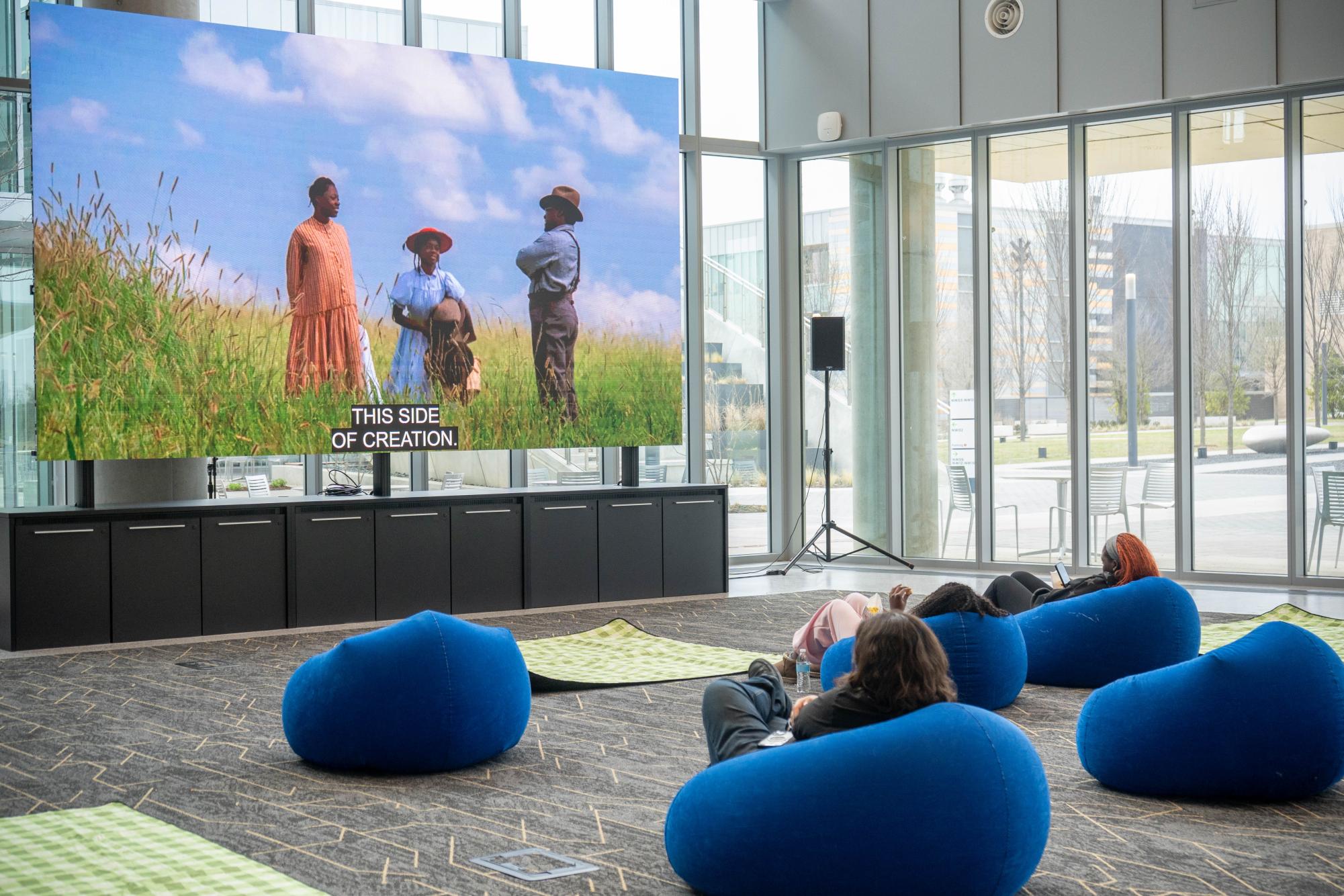
While students grabbed their popcorn and waited on the learning stairs for the movie to be projected, a screening of “The Color Purple” began.
“I think it’s an incredible story because it really does hit home on a lot of key sensitive topics like domestic violence and abuse,” NW Film Club president Madison McCarthy said.
The club typically meets on Tuesdays at 4 p.m., but that changed on March 4 when they collaborated with the African American Student Organization.
As president of AASO, Yasmini Nuru said the clubs agreed to select a movie that would recognize not only Black History Month, but also Women’s History Month.
“It represents a lot of sisterhood,” she said. “A lot of the hardships as a black woman, especially back in those days.”
The 1985 film directed by Steven Spielberg was nominated for 11 Academy Awards. The film revolves around Celie, played by Whoopi Goldberg, a Black woman who endures abuse in multiple forms: domestic violence, sexual and verbal abuse.
At just 14 years old, Celie is impregnated by her father and watches her children be taken away from her at birth. Her trauma deepens when her sister, Nettie, is thrown out by Celie’s abusive husband.
For many watching, students said seeing the struggles portrayed on the big screen was a heavy and sensitive topic at times.
“It was really emotional,” NW student Indio Waggoner said. “It moved me to tears a couple of times. It’s been one that I’ve known it’s existed for a very long time, but I’ve never actually watched it. I’m glad I got to, finally.”
Beyond the emotional impact, McCarthy said she believes that watching this movie teaches people to think about things they may normally ignore.
“Even though we have overcome a lot of our differences, and we’ve kind of pushed those barricades down as a society, it’s really easy to regress,” she said. “If people don’t even come to watch movies, who’s to say that they’re reading about this kind of stuff? I think movies in general are very important to have, because it serves as visual engagement for people who wouldn’t otherwise read or know about this kind of stuff, or these real stories that have happened.”
The film comes to a resolution when Celie and Nettie are reunited with Celie’s children. Although her kids had already grown up in a different country and speak another language, they find peace in knowing they’re finally together again.
Film Club student Joshua Bolaños shared his reflections on the ending of the movie.
“I think it represents love on a different level, like love they can’t find,” he said. “They didn’t understand each other, but one language that they both knew was love.”