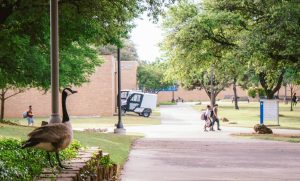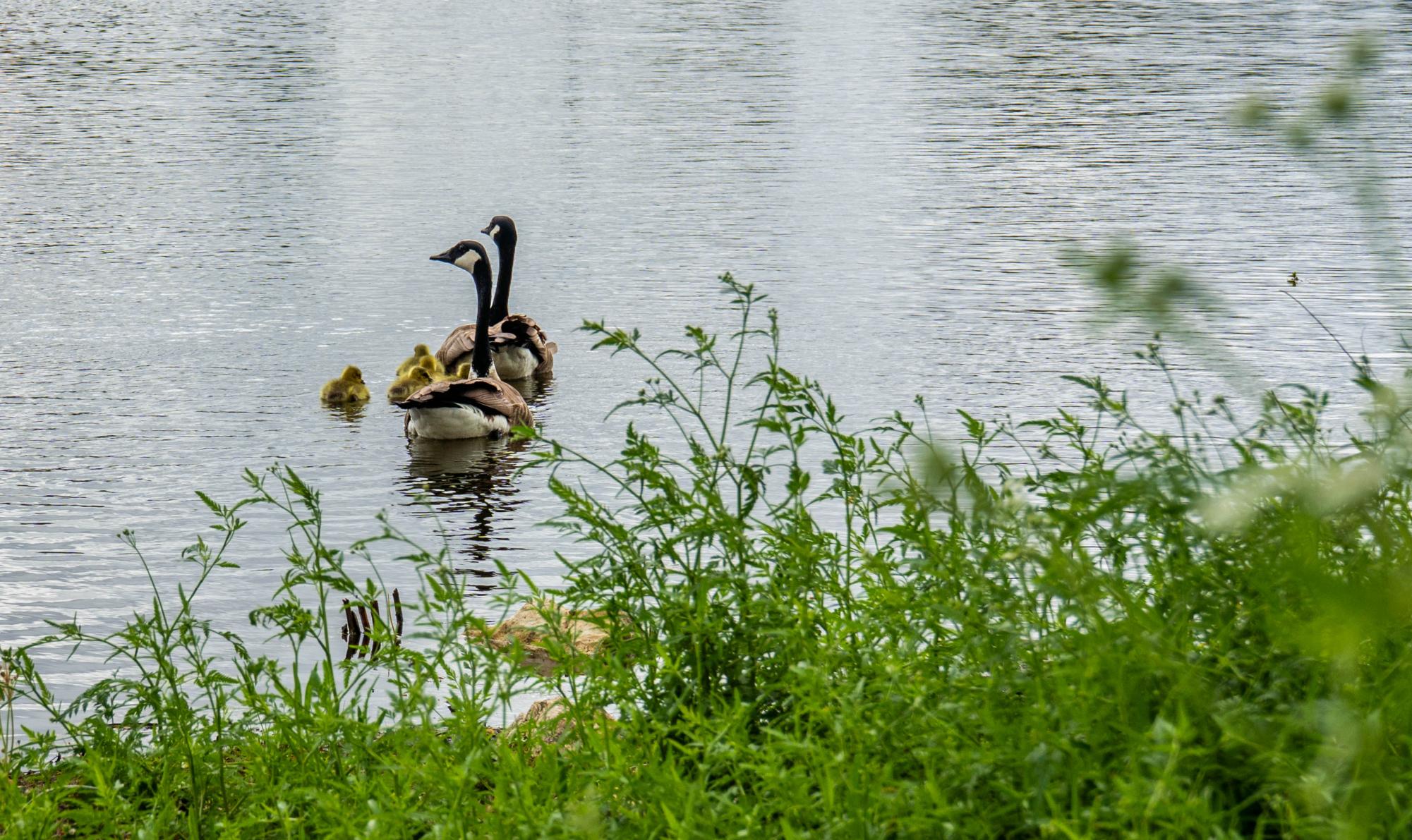

With dark faces like bandits and penchants for making a racket, Betty and Gary can be found running around campus, digging in the bushes and taking naps in the grass.
However, they are not two odd students or local troublemakers loitering on campus.
They are geese.
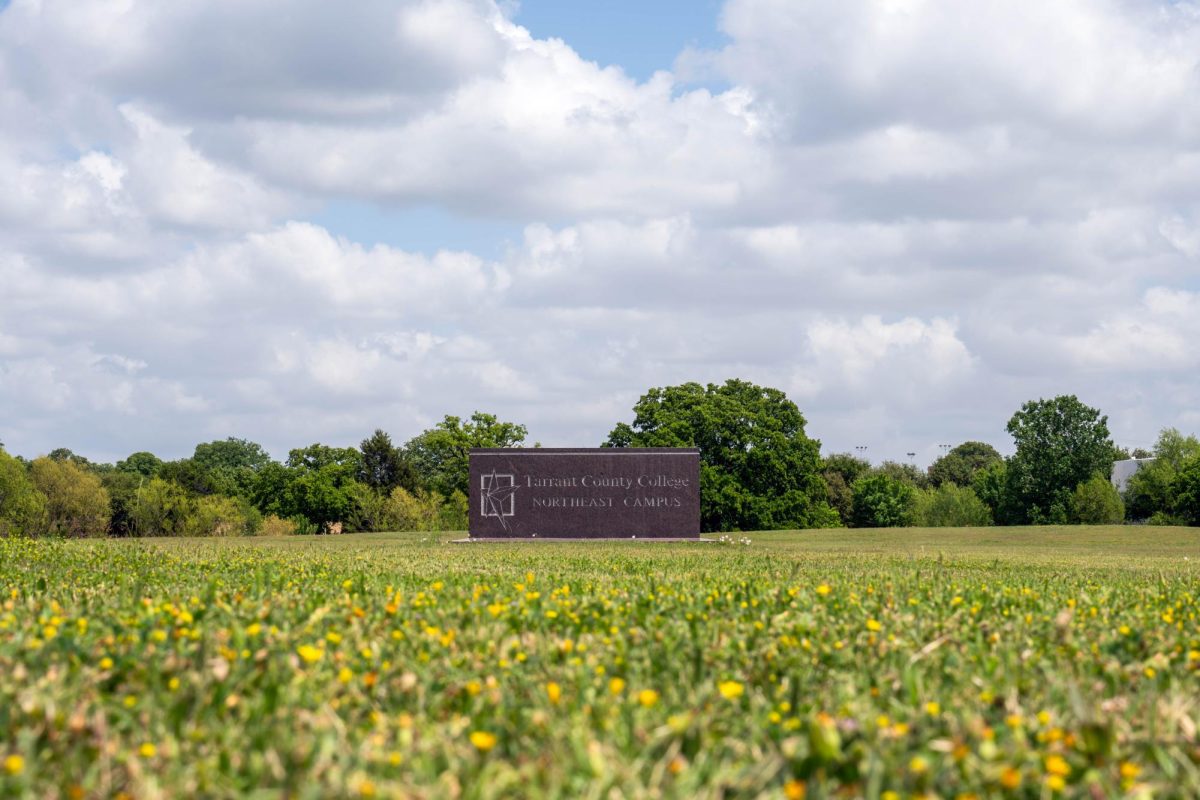
Every spring, the Canadian geese visit NE Campus in search of a haven to build their family.
“For years, these geese have been coming back and nesting every year,” NE administrative events coordinator Kristen Stripling said. “Now, are we 100% sure that it’s the same geese? No, but we really have a pair of geese who come every spring and have a nest and lay eggs.”
This year, students and staff were given the opportunity to check in on the birds’ hidden nest through an official TCC YouTube livestream, affectionately dubbed the “Goose Cam.”
At any time in the day, students could pop into the livestream and hopefully catch a glimpse of the budding bird family. The sole camera was fixed directly above their nest, whose location was hidden from the public to protect the birds’ privacy.
When the sun was still peaking over the campus buildings on April 11, the eggs hatched. The camera captured five tiny goslings’ first moments in the world. Since then, the geese and goslings have circled around the campus. Students and faculty stopped by to marvel at and take pictures of the little family.
Stripling, who came up with the “Goose Cam,” said she thinks the geese’s presence on campus and the livestream are a fun, family-friendly way to connect with campus nature. She said her team is putting together a “geese highlights” compilation for YouTube, since the livestream has ended.
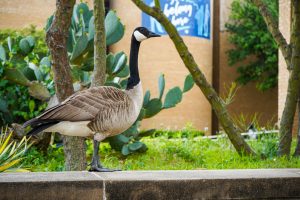
NE librarian James Ponder recalled seeing geese on NE Campus every spring of his 20 years of TCC employment.
“There are a few times that I can recall, as recently as this past Wednesday, two days ago, when a couple of them tried to come in through the [library] front door,” Ponder said with a chuckle. “Students or staff are walking up and kind of wait for them to realize they can’t get in and then move on. But they’ll come around and look for bugs or seeds or whatever they’re chasing after. We learn to give them a wide berth.”
Ponder said he enjoys checking on the livestream because it’s a “way to observe nature without getting too close.”
While the geese are overall passive and tend to keep to themselves, they have been known to approach and even chase students and faculty on campus.
“Not gonna lie, big birds scare me a lot, but I don’t mind them being here,” NE student Martell Ruise Jr. said. “No, it’s just a planet that we all share. … We’re impeding on their environment. So, I don’t believe that we should push any animals out.”
NE student Kiki Jackson shivered as she described how she was recently “jumped” by the geese near the parking lot while she was waiting for her Uber. She called it “the most terrifying moment of her life.”
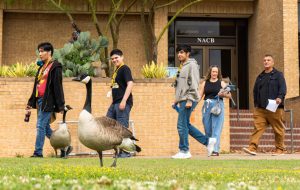
“Honestly, it’s not like I was really hurt in the moment,” Jackson said. “The animals were here first, so we’re kind of in their space. … I’m not super bothered by it., I would just steer clear.”
Despite the signs throughout campus warning of biting geese and the harrowing student encounters, Stripling assured there is no real danger.
“We put the word bite to put the fear into people, but like they nip at you,” she said. “There’s no teeth of anything. … We’re not worried about [it].”
NE executive assistant Kelly Gibson said she checked in on the geese regularly. “As soon as I saw [Betty’s] nest, I was checking on her every day, making my little 15– minute walk in the morning,” she said. “And then she stood up that Friday before spring break and I was like, ‘Oh my gosh, there’s eggs in the nest.’”
After the eggs hatched, the gaggle waddled to the campus pond.
Stripling recalled her favorite memory of the geese from her first year, when she had seen one of them use it’s bill to scoop up a gosling struggling to jump up a curb in one of the parking lots.
While it is a joyous occasion to see the goslings waddle around, the geese will be missed on campus.
“They are a family unit for one year and then when it’s time, when Betty goes to lay more eggs, I guess they are out on their own,” Stripling said. “It’s a kind of stop and smell the roses mentality with our geese here.”