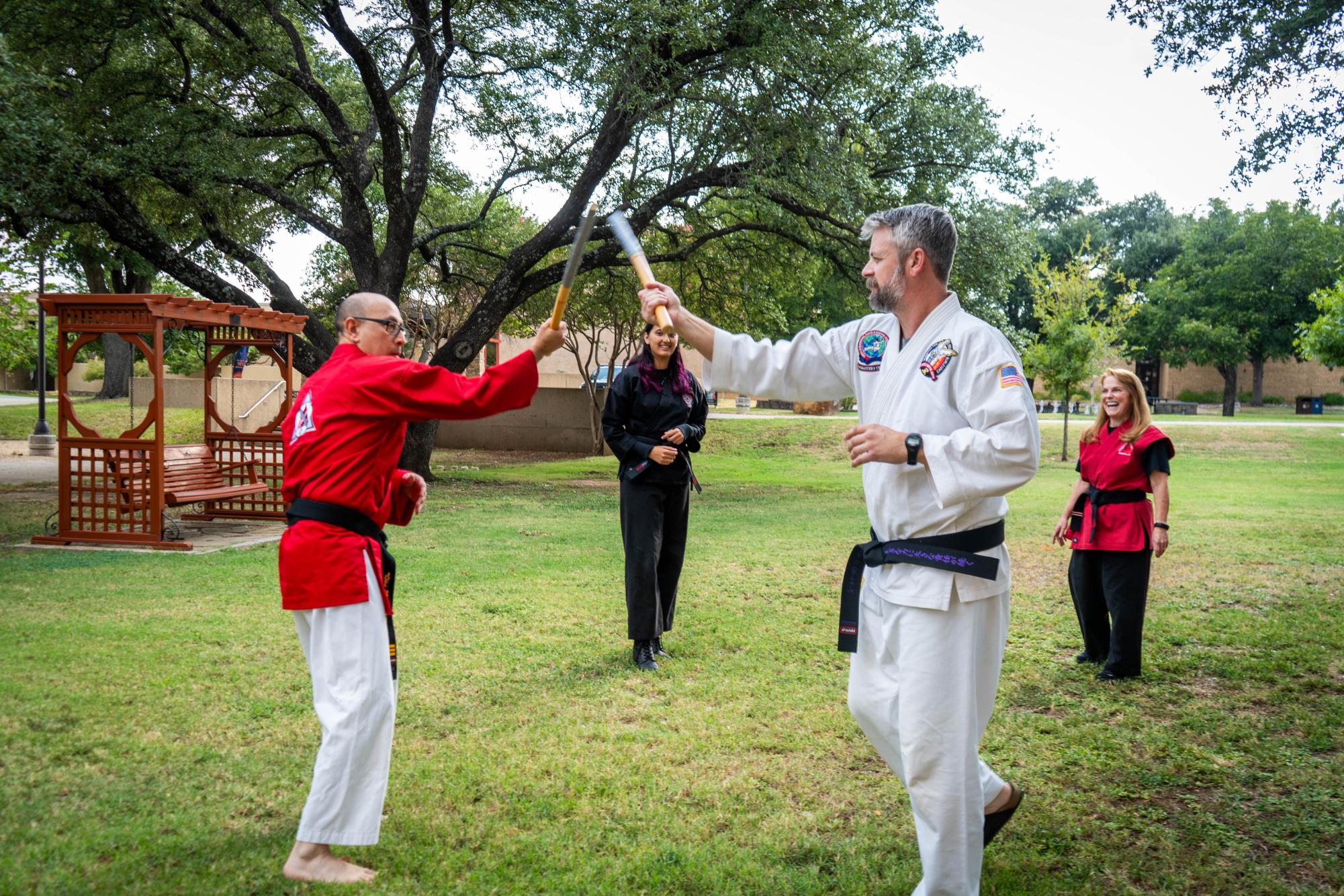

The sharp sound of wood clashing echoed on the deserted lawn. Two NE math faculty members dressed in robes swung wooden sticks at each other, brows furrowed as they anticipated their opponent’s next move.
This was not an epic brawl to determine good or evil. It was a friendly spar on campus between co-workers.
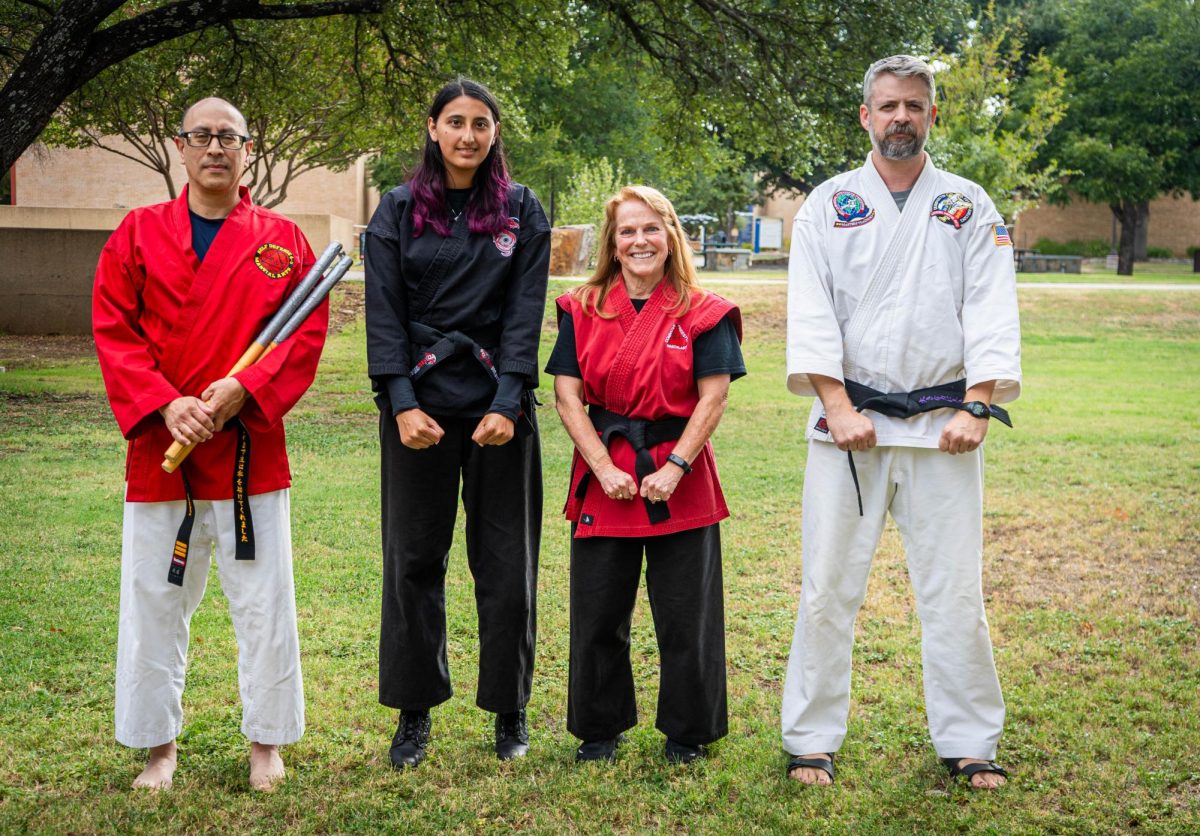
Four NE math faculty members share not only the department they work in but also the discipline of martial arts.
Assistant professor Joel Gutierrez and instructor Grant Griffin said during the COVID-19 pandemic, they would go out to the rock garden in front of the NSTU and run through different self-defense exercises until they built callouses on their feet.
“Once you meet a martial artist, you’re friends for life,” Griffin said. “That’s just how it goes.”
The four said they aren’t sure if there’s a reason that they are all math teachers and also into martial arts, but they do know that at TCC, it’s not only the math department that’s ready for battle but also a few faculty who teach history, English and more.
However, Gutierrez said the math department definitely has the most martial artists.
“I think it just points more that anyone can do it, rather than, ‘Why is it just math?’” he said.
They all began their own journeys with martial arts for one reason: family.
Math adjunct instructor Yasmeen Shaw started karate alongside her brothers when she was 5 years old, and she has stuck with it ever since.
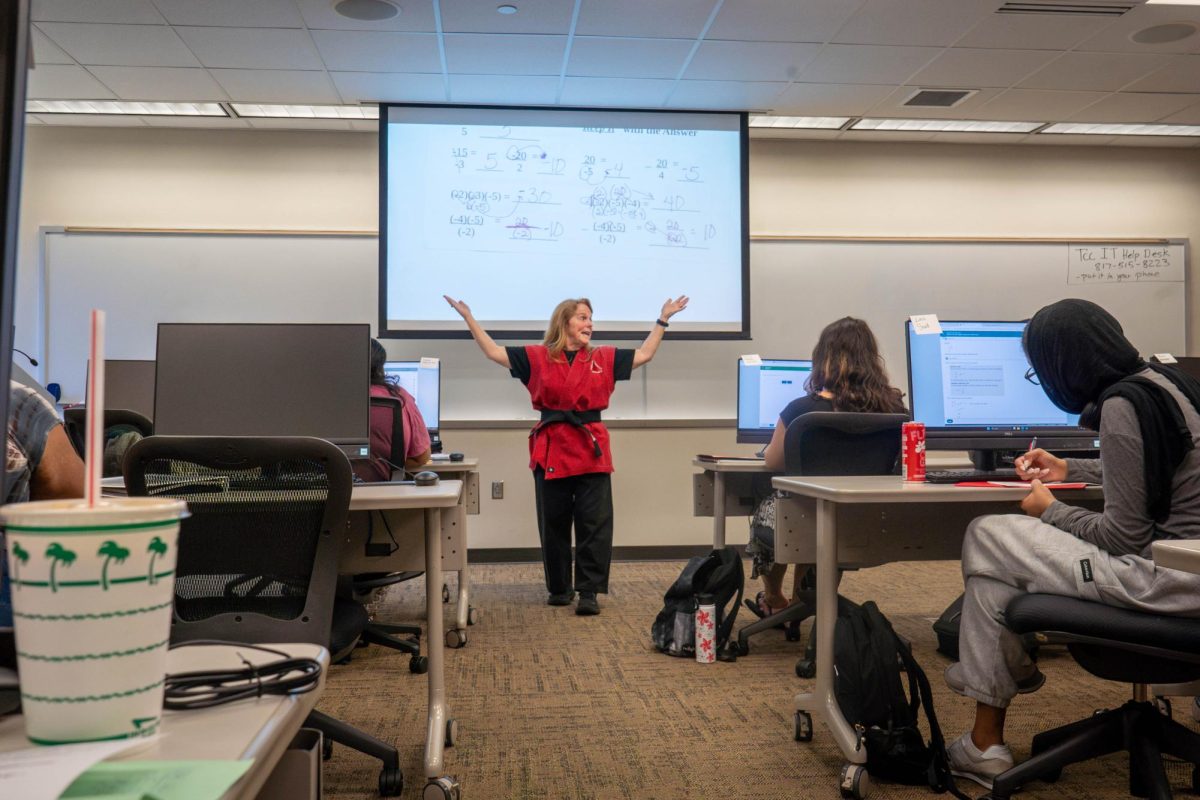
Now, she is bringing her experience with teaching martial arts at her family’s karate school to her first semester teaching at TCC.
“I’ve been teaching since I was 9 years old, so I’ve learned a lot about teaching from teaching karate,” she said. “Everybody learns differently, and so you have to approach it differently for different people.”
Shaw currently lives a teaching double-life with business math and contemporary math classes on NE Campus and women’s self-defense with her mother at Shaw Martial Arts in Irving.
Math adjunct instructor Kathy Carroll originally enrolled her children in a combative freestyle martial arts class as a way for them to focus their energy on a goal, but shortly after, she and her husband also joined.
“We said, ‘Well, we can sit over here waiting, you know, and just getting old and out of shape, or we could get out on the mat with them and learn all that cool stuff too,’” Carroll said.
Carroll doesn’t currently practice karate, but her time in the dojo has given her certain confidence in the way she carries herself.
“I would think for any one of us here, if there was, I don’t know, some rowdy whatever on campus that was getting to be a problem, you know, somebody could handle that in a calm way,” Carroll said.
Just like Carroll and Gutierrez, Griffin was introduced into the martial arts world because of his child.
“I had a 5-year-old with ADHD that I couldn’t get him to sit down long enough to do anything, and he was just always getting into things, so I thought martial arts would be a nice outlet,” Griffin said. “After about two months, it was ‘OK, I immediately see the benefits that my 5-year-old is getting.’”
After trying out several different self-defense schools, Griffin said he enrolled his son at Legends Martial Arts in Hurst because of the community environment there. Originally, Griffin stayed off the mat but decided to try martial arts after some encouragement from Gutierrez, who also attended the same studio.
“I, with some prodding from my colleague here, decided to get off the bench and do what a lot of other adults have tried to do: step onto the mat with their kids,” he said.
Griffin said things have come “full circle,” as he was hired by Gutierrez around twelve years ago, and recently he hired Shaw, bringing in the next generation of martial-arts-math faculty.
“It’s been a wonderful journey and I love being here,” he said. “This is where I’m going to be forever. Yeah, they’re going to have to drag me out of my office and say, ‘You’re not fit to teach anymore.’ … Teaching is about making connections with people and helping them to see something that they don’t see in themselves.”
Gutierrez specializes in American karate and Kali, a martial– arts style from the Philippines. Out of the four faculty, he has taught at TCC the longest, coming up on 21 years now.
One of the biggest lessons Gutierrez has learned from martial arts and one he often applies in his classroom is that sometimes it is better to approach a problem gently rather than headstrong.
“It doesn’t help to try to be too powerful, for lack of a better word, because two things happen: You don’t learn and somebody else doesn’t learn,” he said. “Instead of pushing like, ‘Let’s go to the next thing, to the next thing, to the next thing.’ Then, you realize it’s like, ‘Let’s make sure that people understand this, and then we can move on.’”
Gutierrez mainly teaches math classes, but occasionally he has helped instruct special sessions at local martial arts studios.
“I’m trying to encourage my students to say like, ‘Don’t worry whether or not you get it right, because it’s about taking chances,’” Gutierrez said. “It’s OK to fail now. It’s not OK when you fail on the street because on the street is when that’s your test.”