Resting beside the TCC Southeast lake, a once-humble garden has grown into an oasis of sustainability and innovation.
Accompanied by the steady hum of insects and wildlife, the site serves as an example of how items once condemned to landfills can be repurposed to foster new life.
Spearheaded by professor Bradley Borougerdi, the volunteer-run garden has expanded significantly in recent years. With the addition of fertile growing sites, rows of fresh plants and a newly installed greenhouse, the space has grown in both size and purpose.
Borougerdi installed an aquaponics system nearly a decade ago, a soil-free method of growing plants using fish waste.
“We’ve just got the greenhouse on it last year, so I was operating this thing five years ago or so without [one],” Borougerdi said. “It was kind of hard because in the winter everything would die. Now these plants have been alive all year long.”
Another improvement to the garden is the expansion of several Hügelkultur mounds, a German agricultural technique that uses decaying organic matter. Borougerdi said this practice helps retain moisture and reduce water consumption.
The growth of the garden is driven in part by Borougerdi’s commitment to repurposing unwanted materials to save both money and the environment.
A scrapped sofa, repurposed school sinks and jars of food waste have all been used to support the garden’s ecosystem. These materials transform infertile Texas clay into nutrient-rich soil, supporting plant life while retaining moisture and reducing waste.
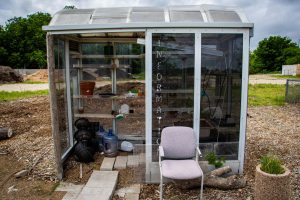
“There were quite a few things here and they kind of got upset with me that it looked like a junkyard,” Boroguerdi said. “So, they made me get rid of a lot of things, but still practically everything here I get on my own. I don’t buy anything really.”
Blending into the eclectic environment, several large concrete sinks taken from the school sit unassumingly as makeshift planters. Flourishing green plants sprout from the tops, supported by rejuvenated soil.
Borougerdi said he tries to make sure nothing provided to him goes to waste, including fish skeletons provided by students.
“I tell people if you go to a restaurant or something and you get fish, bring the shells, bring the guts, bring the bones to me,” he said. “So, I get a five-gallon bucket, fill it up with water, dump all that stuff in there, seal it up, shake it around every once in a while, for about six to eight weeks. Open it up, smells like crap, but it’s a really good natural nutrient fertilizer. It’s about not wasting anything.”
His commitment to repurposing is not only practical; it is rooted in a broader philosophy centered on reducing waste and rejuvenating the land through natural means.
“I wanted to teach students to learn how to do things with what they got,” he said. “We have this really horrible gardening system in our country, that’s monoculture tearing up the ground, plowing the ground, dumping animal fertilizer on there. And we’re trying to show a different way of doing it. You can call it regenerative gardening.”
Beyond its creative use of materials, the garden also provides students with access to healthy, freshly grown food while demonstrating sustainable practices.
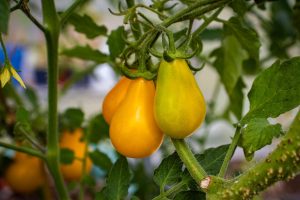
Edible plants fill the space, from flowers that taste of cucumber to bright orange pear tomatoes and clusters of asparagus.
Borougerdi said his goal is for students to be able to come to the garden after class and pick fruits and vegetables to snack on while learning about regenerative gardening in the process.
“We don’t sell it. Sometimes we’ll donate it to the food bank. A lot of students do that with the environmental [club] garden plot,” he said.
Borougerdi is an outspoken advocate for healthy dietary habits and sees this garden as a way to show students that nutritious food is accessible.
“Learn how to repurpose, learn how to be food sovereign, eating healthy foods,” he said. “We talk to our students about … alleviating the biggest problem of climate change, which is our food system, by trying to spend a little bit of time every day working on the land instead of mowing it and all this other crap. Just come out every once in a while, healing it, taking care of it.”
Although Borougerdi initiated the garden project, it has thrived with the assistance of student volunteers.
Under his guidance, volunteers learn how to create fertile compost, tend crops and build new plots that can be used by faculty or student organizations.
“It’s better without having used chemicals, but it’s still really difficult. I know how to do composting a different way [than usual],” student volunteer Yethanuael Johnson said.
Borougerdi welcomes anyone interested in volunteering and encourages students to join the environmental club to stay involved.
“If we’re able to get more people working over here, we could get new ideas because he [Borougerdi] likes new ideas,” Johnson said. “This is a place for ideas.”