






















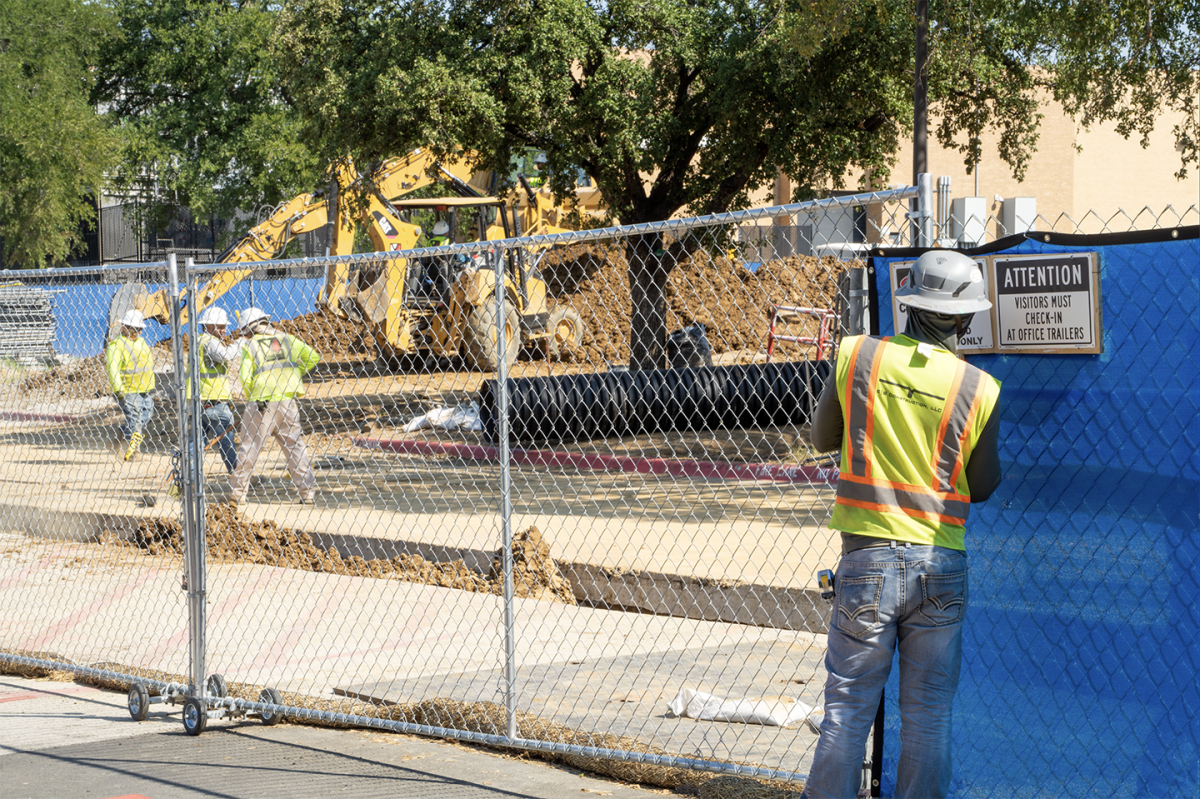
Construction has begun on the new science building on NE Campus, raising both excitement and concern.
Some instructors are not too fond of the idea of shared office spaces. These “faculty neighborhoods” will get rid of private offices, which NE astronomy professor Raymond Benge says will make it difficult to work and connect with students.
“Right now, I have people just walking down the hallway and they’ll see the door open and they’ll stop in and ask the question, ‘Hey, can you help me with this?’ even if they’re not my student,” Benge said. “And that’s not going to be possible in the new building. So, I think that actually takes away a whole bunch of the informal faculty-student interaction that’s so important for teaching.”
However, Marius Pfeiffer, a NE professor of biology, isn’t as opposed to the shared working space.
“People are naturally resistant to change, so while it’s [the faculty neighborhood] not necessarily a bad thing, it will just take time to get used to,” he said.
NE interim president Kirsten Jakowitsch said the building design includes private meeting spaces and student support areas to combat concerns.
“Our goal is to create an environment that supports both collaboration and the privacy needed for meaningful student interactions,” she said.
One thing Pfeiffer does want to see is the incorporation of xeriscaping, which he says is a landscaping method that uses native plants to the area as well as gravel and other sustainable materials to provide a nice landscape that uses minimal water.
“While we aren’t technically supposed to have wildlife on campus, that doesn’t mean that we don’t. There are squirrels, birds, sometimes coyotes and of course the geese,” Pfeiffer said. “So, I think it would be nice if they were able to also support the wildlife while using less water.”
Pfeiffer also said he was curious about what this new construction meant for the future of NE Campus renovations.
At the moment, both NE science buildings, NSCE and NSCW, remain in use but will have renovations done as the project progresses.
“The current plan includes renovating and repurposing the existing science buildings after the science programs move into the new building,” Jakowitsch said.
According to a PowerPoint shared by Chief Financial Officer Pamela Anglin, the estimated cost for the whole project including renovations will be $225 million.
Currently, Jakowitsch said there isn’t a set finish date for the project, but Benge and Pfeiffer are hopeful for spring 2028.
Both science buildings are original from when the NE Campus first opened in 1968. Jakowitsch said the new science building represents a major investment in the future of NE Campus.
“It will provide modern labs, collaborative learning environments, updated student and faculty spaces, and expanded opportunities for science education for years to come,” she said.