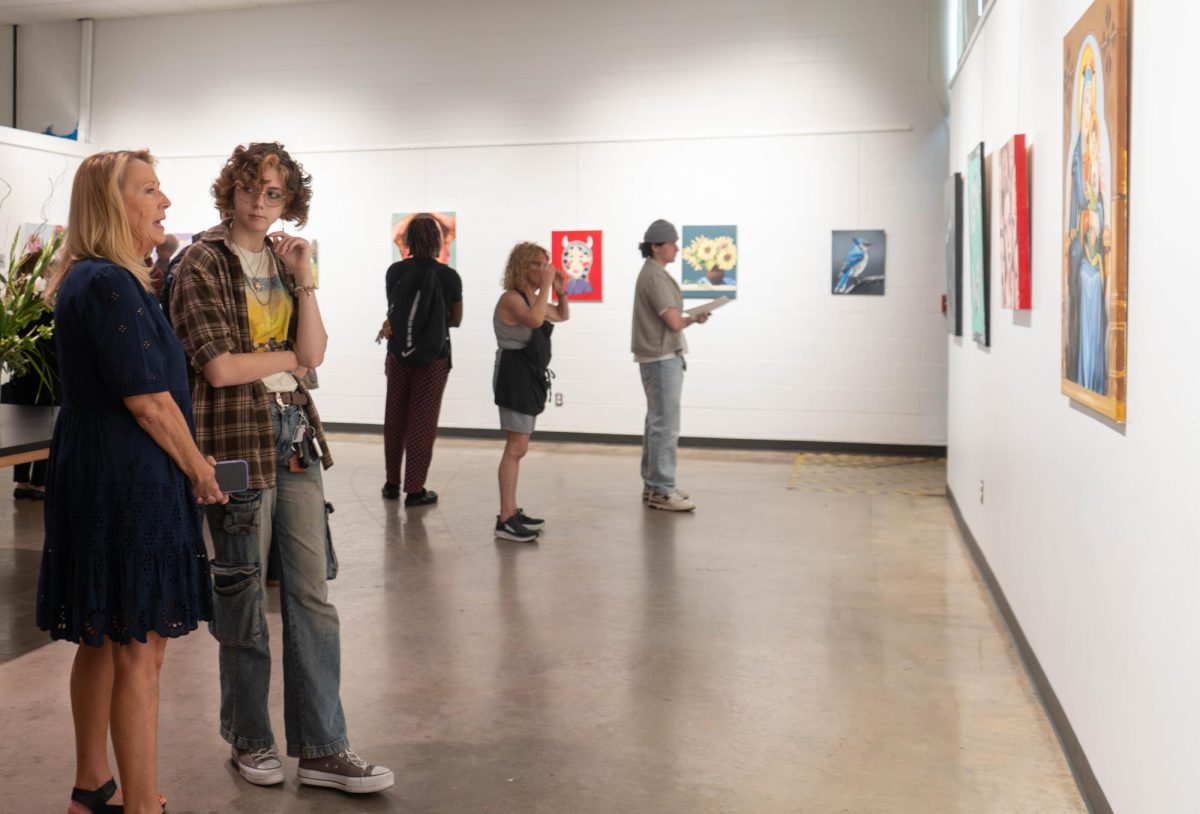
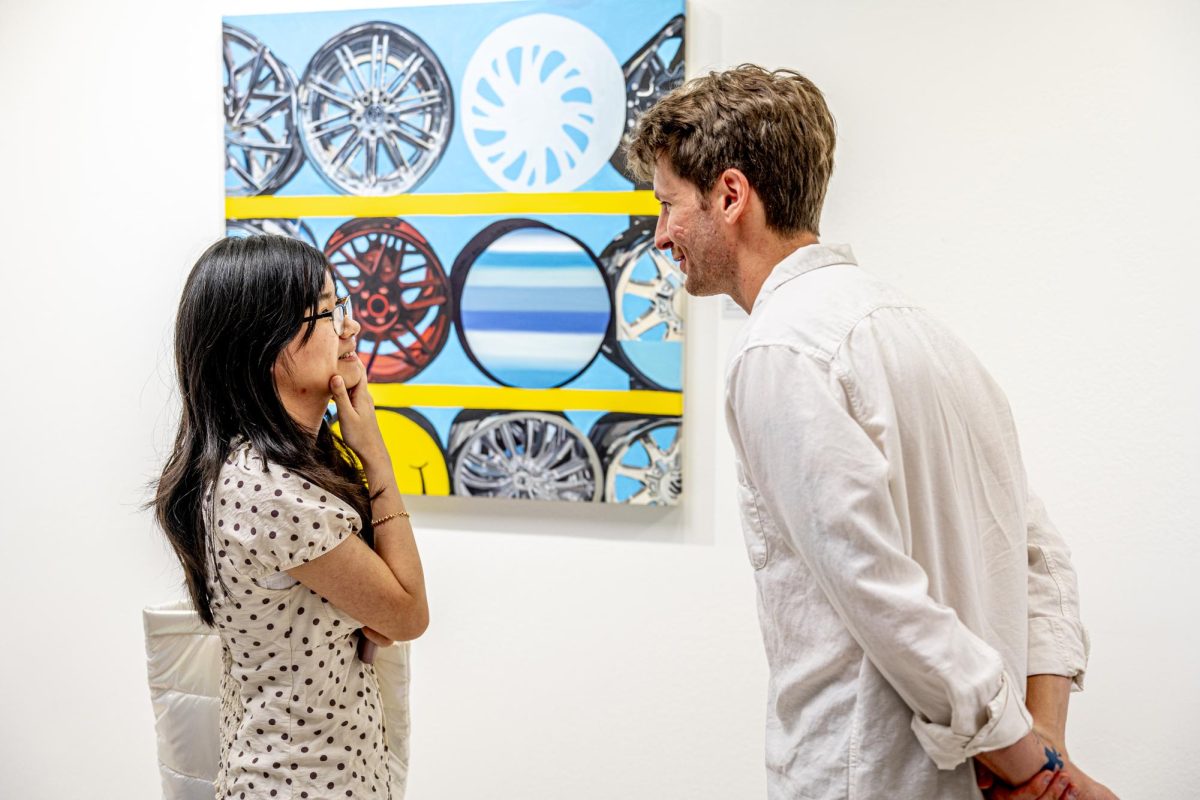
The walls of the SE Campus Art Corridor II Gallery are lined with three unique collections of artwork.
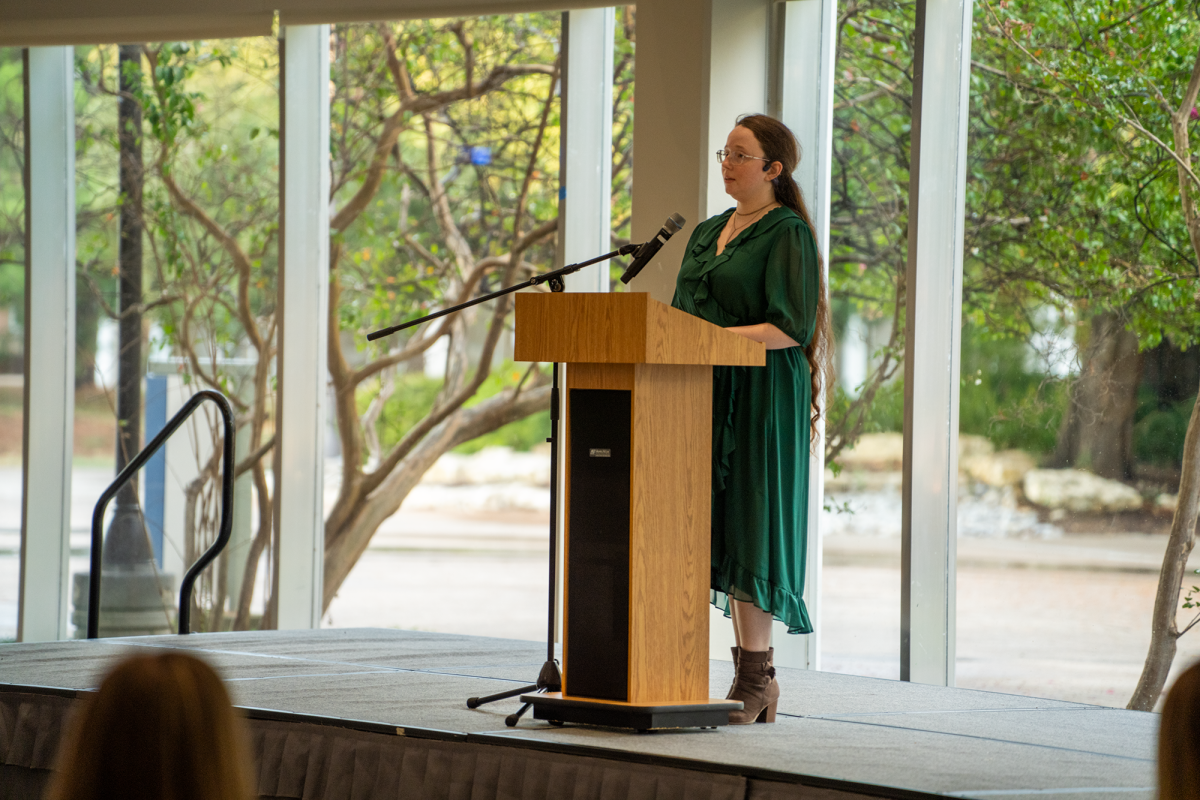
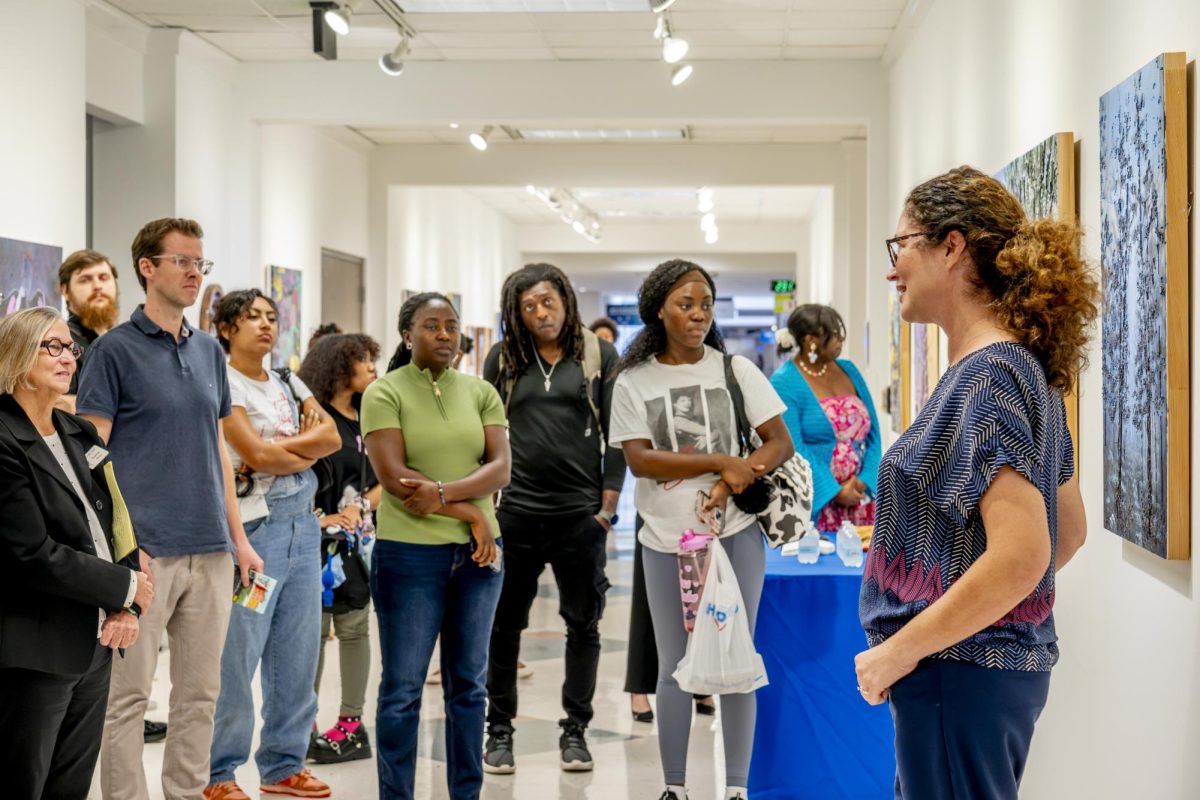
Three Solo Exhibitions held an opening reception on Sept. 3 for the artists to speak with students about their work and answer questions. The exhibitions will run until Sept. 25.
TCC alum Kyle Hanson’s retrospective collection on the evolution of his art from the past decade is featured.
“On Letting Go” featured photorealistic oil on canvas that blended into pop art then morphed into the abstract as he, over the years, began to explore new styles and creative avenues. He said the theme of this show was inspired by his struggle of creating after college while working a full-time job.
“Painting is the one thing that I always come back to,” Hanson said. “I’ve felt very passionately about it for years. I’ll take breaks, and I don’t get on to myself. I don’t get bitter about it like I used to. I think straight out of college, I was bitter about not painting as much as what I expected of myself, but that wasn’t helping anybody.”
His wife Emily Hanson has witnessed the evolution of his styles and focuses firsthand. She said he can be stubborn with what he changes and leaves behind in his work. He tends to underpaint with a vibrant orange but always covers it up, she said, so in the few pieces where the color peeks through, it’s special.
“I am obsessed with it,” she said. “It is just a beautiful highlight.”
Hanson said he sometimes likes to think of his paintings as an excavation where he’s burying, digging and piling on.
“I’ll scrape off sometimes, start anew in some areas, and I really like that,” Hanson said. “It feels like I’m digging for treasure on the surface.”
Digital digging
Mckee Frazior brings a whole new meaning to burying your art.
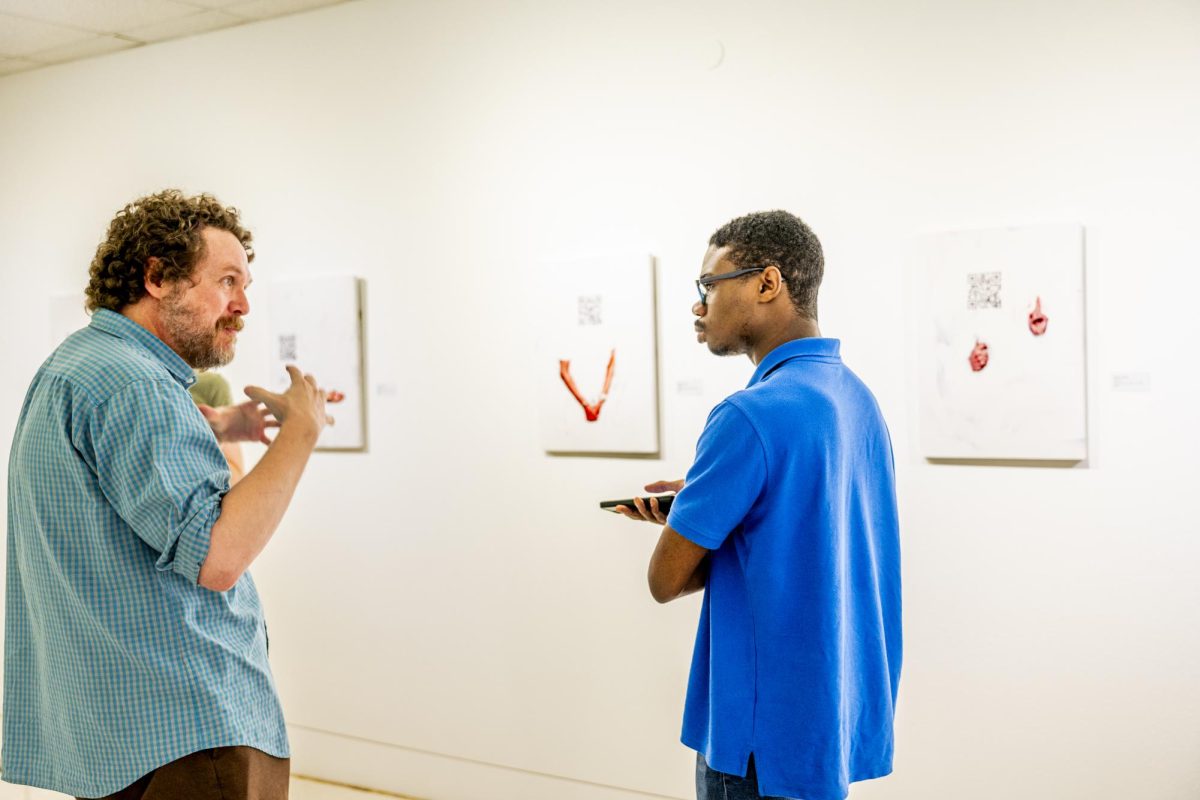
As a hypermedia artist, he used his experience in web and video game development to create an interactive, digital experience with his collection titled “PWRGRPS.” His canvases are tucked away and slightly obscured in an alcove of the gallery hallway. Hands reach out through white strokes of digital paint, and faces are replaced with QR codes to obscure the identities of each piece’s subject.
Scanning the QR code leads to a webpage of the piece.
The white can be scrubbed away to reveal more of the image, but attempting to remove the QR code results in a quote popping up.
Scrub a little more and a deep-fried image of the subject’s Wikipedia page is revealed.
“They’re about tech accelerationism and the people who are taking part in that,” Frazior said. “If you scan QR codes, you can kind of uncover what these different figures are and decide how you relate to them and how they relate to each other.”
SE student Nicholaus Taylor asked Frazior why he included the survey of whether the viewer agreed with the quotes, and he said he wanted to get people’s thoughts out.
“I thought that was really brilliant,” Taylor said.
Back to her roots
Claire Moore unearthed new mediums with her collection “Touch Grass.”
Her work emerged as a consequence of the pandemic.
She couldn’t travel and felt stuck being limited to screens for connection, so she began to experiment with texture in landscape paintings.
“I just was so done with the flatness, the slickness, and I wanted to come back to that in-person, physical presence of being there – of the handmade,” Moore said.
She painted the landscapes of Texas, Colorado and Santa Fe, New Mexico and incorporated textile objects like a road with specks of sand as loosened gravel along a spackled cliffside imbedded with real pebbles. These 3D physical elements on wood panels are highlighted by her use of perspective, where she blurs the deeper background and sharpens the foreground.
Art history instructor Jungwan Kim said it’s important for students to see the work of professional artists because they get to engage with different techniques, processes and perspectives. She said the variety of artistic mediums in the showcase gives students a chance to see how the tools and methods in art have evolved while still being able to connect.
“I can see that even today’s artists are thinking about it,” Kim said. “Like the COVID time painting gives me a sense of our urge to be a human. We want to physically be somewhere or in touch with people. I think these types of paintings, even the paintings leading to the digital world too, still are kind of grasping this human touch. That’s, I think, important today.”
Moore is a native Texan who recently moved back after spending 15 years in New York.
She’s worked as an artist and as an educator at museums in Dallas and NYC, including The Met.
Student impact
SE computer science student Edwin Waltman stumbled into the reception, but he found an interest in each artist’s work. He compared how Moore’s art pops out through its realism and physicality while Hanson’s art pops out because of his use of color and distinctive symbols.
“I didn’t really have anything to do – outside of class – but I just stuck around and it’s been really interesting,” Waltman said. “I didn’t expect to get a full art expo in the afternoon, but it was nice.”
Hanson said that showcasing his collection to TCC students was a full-circle moment for him, and he’ll be forever grateful to arts professor Dana Ferrara, who opened the world of painting to him in her classes.
Her guidance not only showed him how to paint but also how to see and define meaning, curiosity and possibility in active creating.
“I’m honored to be any little iota of his story,” she said.
What keeps her motivated as a teacher and an artist is delving into the humanity of art.
“We don’t just paint pictures to hang over sofas,” Ferrara said. “These are people’s lives that we have an opportunity, through … their willingness to be vulnerable, to partake in that [humanity] and learn from that.”