

















The most valuable resource on Earth is the human mind, with its bottomless well of intuition, ever growing intelligence. and ability to critically think faster than any un-trained bot could.
Massive social media giant Meta, and other conglomerates, are leeching the power of the human mind, to develop and train their bots to respond just like a human. Corporations have pillaged user content to do this for decades. We’ve finally caught them in the act.
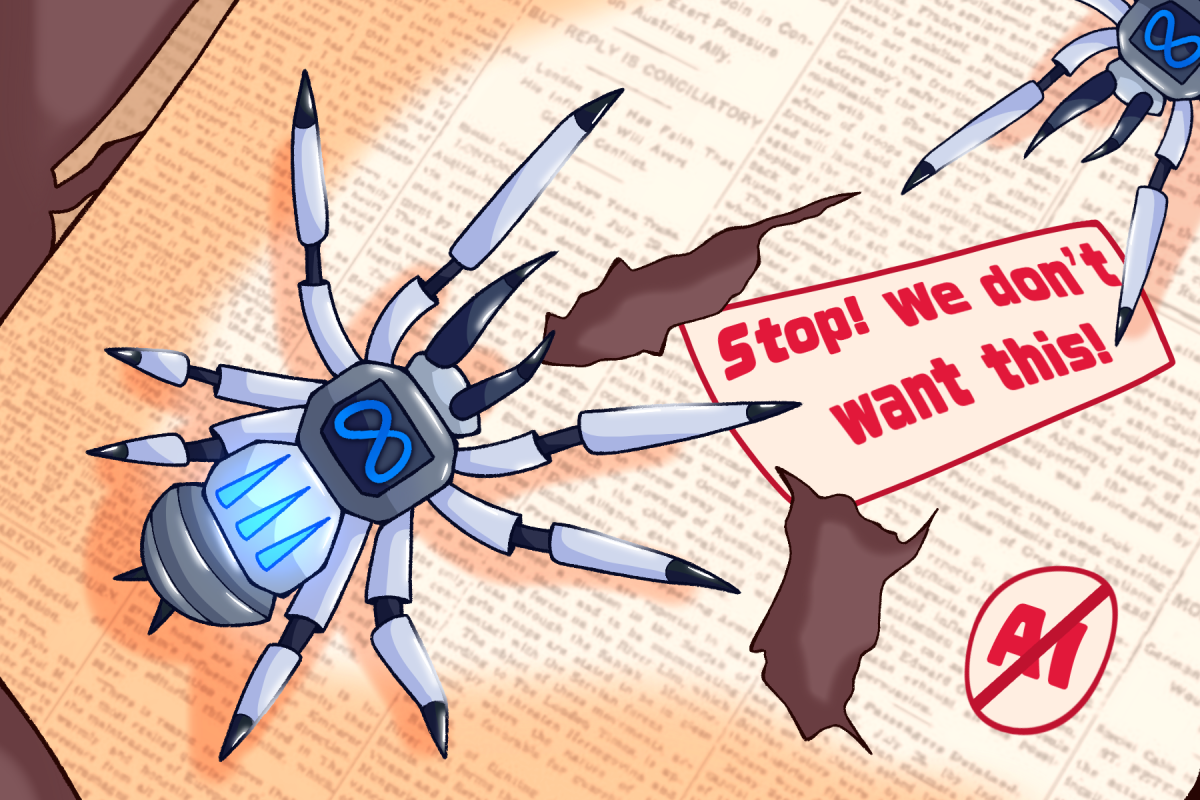
Earlier this month, Meta said – in a blog post no less – that it would begin using spider bots, robots that sift through web content and deliver information back to a host, to rake through the data of business account users on Facebook and Instagram for their own gain. These rakes will be able to “access, analyze, index, cache, collect and retrieve” all content available through Meta business accounts.
They’ve projected their new privacy and licensing terms to take effect on Oct. 30. At that time, they’ll be able to extract and use data for whatever they want, however they want, and users must accept it if they want to continue working with Meta.
All Meta users are subject to the scraping, but personal account users are able to opt out. It is intentional that business account users like us here at The Collegian, or larger news media outlets like The Guardian, The New York Times and The Washington Post, are obvious targets, that can no longer opt out of this overreach.
Tech giants are finally admitting that they need what we have — the ability to write and create content. They want this ability to train their bots to make the most powerful artificial intelligence machine the internet has ever seen.
In early 2024, five media giants sued Facebook for pirating millions of their works, as reported by The Guardian. These giants included creators of learning management systems like McGraw Hill, Cengage and Macmillan, all companies who’ve built groundbreaking technologies for students and teachers at all levels of education. In this lawsuit, they claimed that Meta, specifically Facebook, had employed their work to train Meta AI bots to create AI language tools.
Over the last five years Microsoft was also sued, with reports of Open AI’s Megatron misusing copyrighted material to train AI development of the well-known ChatGPT. The writers of over 200,000 books collectively accused Microsoft of stealing their content to develop Megatron.
Most recently, on October 21, Meta was ordered to pay $25 billion in penalties for misleading information about how Meta uses information and data gathered from its users.
And now here we are, watching as Meta sounds the battle horn, saying that it can and will begin aggressively using our data for anything it wants to continue training bots and AI generators to give them the intuition and intelligence humans naturally possess.
Danielle Coffey, president and CEO of the Media and News Alliance, wrote an open letter to Mark Zuckerberg declaring that it’s unreasonable for Meta business account content to become open source for undisclosed purposes without consent.
At The Collegian, we agree that the content writers generate is theirs and theirs to control. We see how big tech has attempted again and again to troll us, steal our data, misuse our information and mislead us in their intentions to mimic us. It’s insulting at best and ultimately fraudulent, damaging and unoriginal.
We understand we’re right where they want us to be, paralyzed by mega media companies that know we have little choice but to continue using their products. As a news outlet, we experience most interactions with our readers through Instagram, one of Meta’s largest platforms. Last month alone we hit 30,000 views and to nix this part of our circulation would be a severe blow to the connection we want to uphold with students.
With further use, these AI models could build machines that compete with our writing, content and products.
Eventually, AI would become so powerful through the stolen “training” from its users that there would no longer be a need for human intuition. We’ve been tricked into training computers to do it for us.