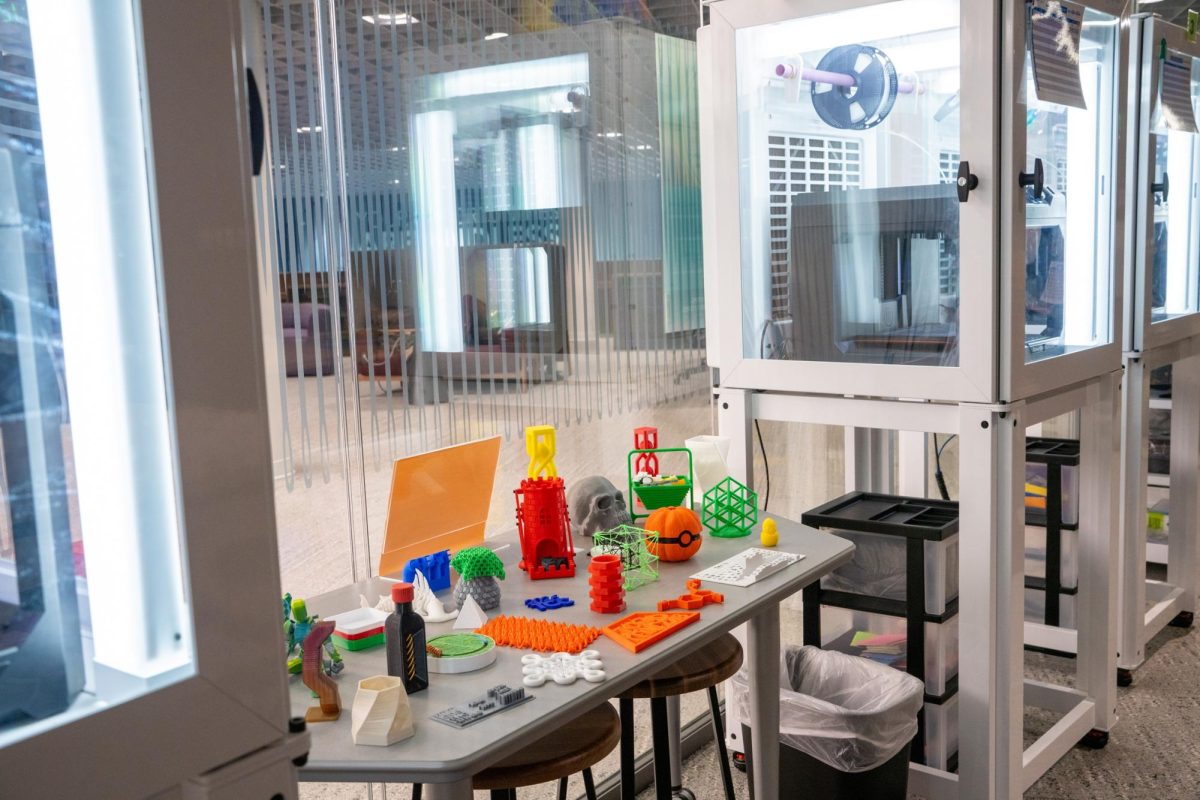





The line between the worlds of art and science blurs through design, technology and engineering with a host of 3D printers available to students at various TCC campuses.
The SE and NW campuses host a small makers lab as part of their Learning Commons while South and TR have a printer available for students with a restriction on print time and print material needs. At NE Campus, students can use the 3D printers within the library for up to 200 grams of filament per semester free of charge. On all campuses, a faculty or staff member will assist students with 3D printing needs.
Sean Puckett, SE staff member, student and 3D Printing Guild club adviser, has worked closely with students in the lab since its opening in fall 2025.
“The 3D Printing Guild is a student-led club that explores creativity,” Puckett said.
The club creates space for student-to-student mentorship as well as staff advising on how to use 3D modeling software. Puckett said the club meets every Wednesday and Thursday in the maker lab inside the Library Learning Commons on SE.
“I think 3D printing is at that early adoption [stage],” said Andrew Strohschein, SE library manager. “In another five to 10 years, we’re gonna see really massive advancements.”
Strohschein has overseen technology and computer services at the SE library for 29 years. Now, he works with faculty members providing 3D printing instruction to art and engineering classes.
Strohschein predicts 3D printing will become a new household utility similar to high-speed home internet and the paper printer. Integrating 3D printing instruction allows TCC to prepare students for this new opportunity in the workforce.
While the lab has the support of student mentorship through the 3D Printing Guild and a full-time manager, Strohschein and Puckett said they would like to see the lab grow to its full potential. This type of capability would offer regular integrated class projects to a mixture of design and engineering with student-to-student mentorship. Strohschein said that traditionally, this type of growth is difficult for two-year colleges.
“The plan for the future is to continue to grow and nurture the development of the students while at the same time building up a selection of tools of what we offer in the Maker Lab,” Puckett said. “We have recently been looking at grants and other sources of funding to assist us with reaching these goals.”
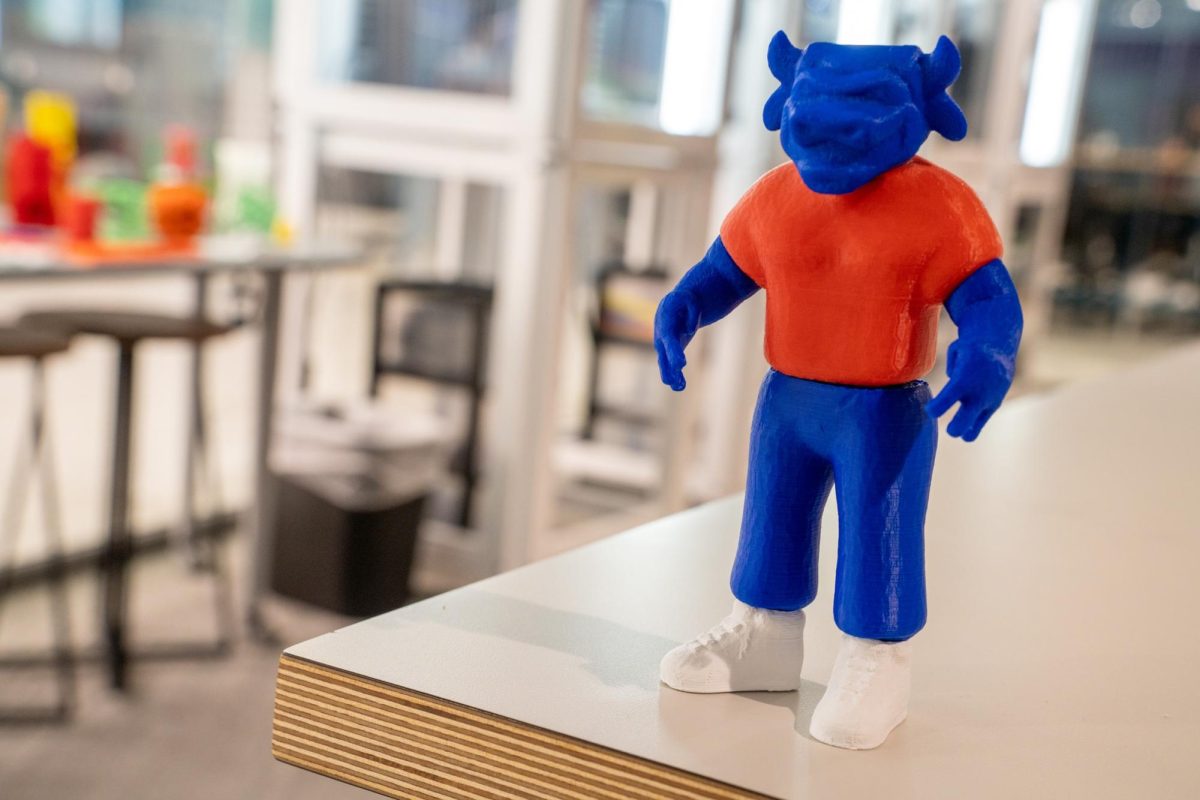
Puckett has an arts degree but decided to pivot with the growth of AI integration into the workforce. While he mentors students in the 3D Printing Guild, Puckett is looking forward to another semester as a TCC student. Some things Puckett created are entirely original designs, such as “Buff Toro,” a muscular version of TCC’s mascot. Over a nine-month period, Puckett designed, printed and glued together “Buff Toro” from the shoelaces to the horns.
“The purpose of the magnetic print was to be used for a scavenger hunt where students would collect all the parts to assemble a full Toro,” Puckett said. “The magnetic request had never been done before, but we in the maker lab were eager to take on the challenge.”
SE student Tanson Nguyen joined the 3D Printing Guild with no prior experience with 3D printing in September. Since joining the group, Nguyen worked on several of his own 3D printed models, developing them mostly outside of the lab and collaborating with club members on ideas during meetings. For one of his latest 3D projects, Nguyen engineered a Sonic character costume head for the upcoming Sonic Expo in Dallas.
“Try out the club,” Nguyen said. “It’s fun. You could make loads of friends in it, and you could just be yourself. Be yourself and bring whatever you can to the table.”
The makers lab opened on SE Campus a little over a year ago, but the campus has had a set of 3D printers for nearly eight years. Strohschein has worked closely with students since acquiring 3D printers to help them turn their ideas into reality.
“Creativity and innovation are in between,” Strohschein said. “We think of science and art as being these completely opposite things. I don’t think there is a divide, and I think insisting on a divide really does both sides a disservice. I would love to bring [both of] those kinds of students together.”