



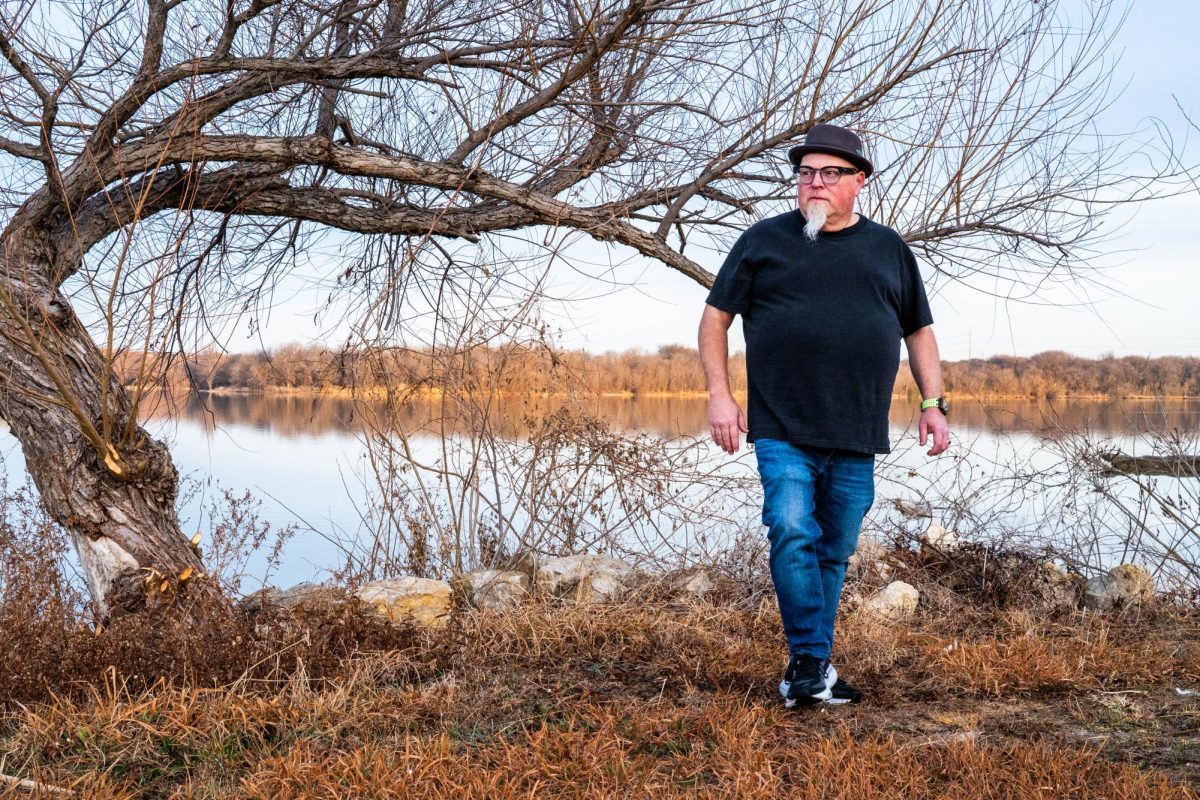
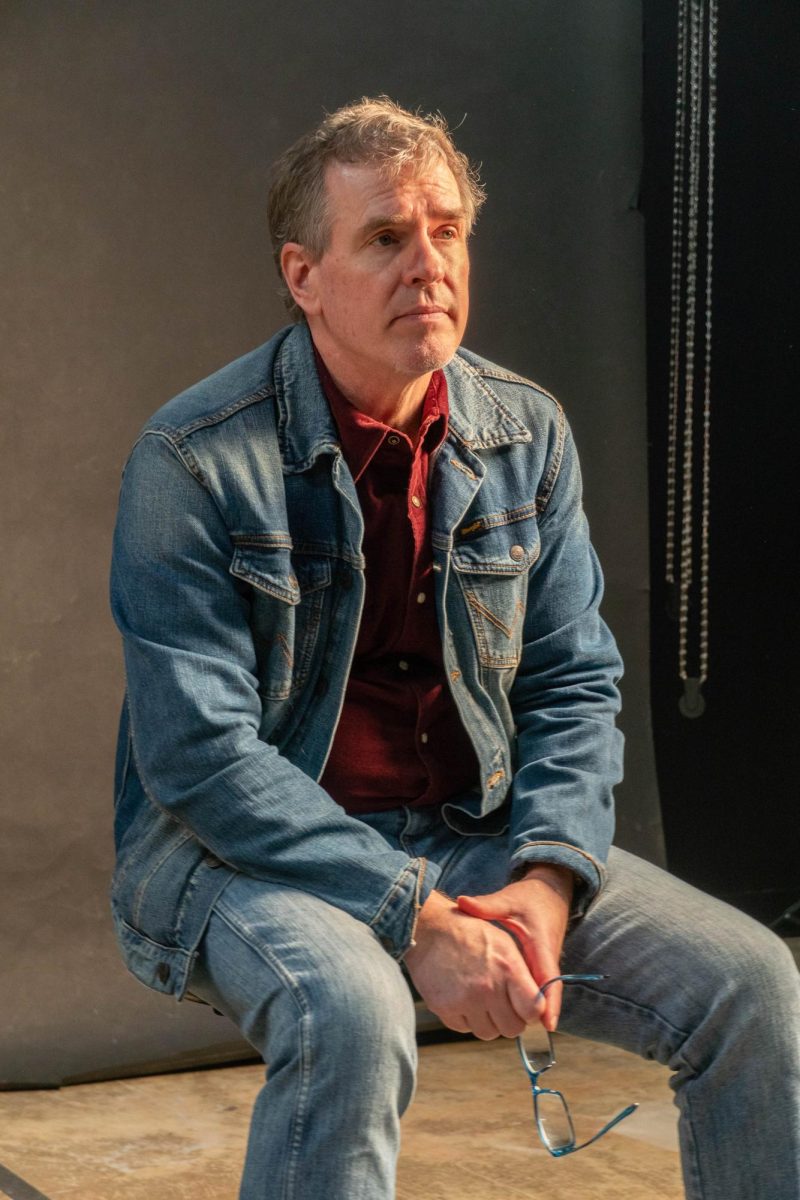
NE Visual Arts adjunct Michael Mulvey has been involved with the photographic craft for most of his life.
While working for The Dallas Morning News, he and his colleagues won the 2006 Pulitzer Prize for breaking news photography for their coverage of Hurricane Katrina. Later in his life, due to a shift in photojournalism and his desire to diversify his knowledge in photography more broadly, he gained his Master of Fine Arts at Texas Woman’s University and entered his current role as an educator.
Q: When you won the Pulitzer in 2006 how was that, how did that feel having one of your works included in that Pulitzer award for the Katrina Hurricane?
A: I don’t think that any one person could have won, it was too big an area and too many complex things. So, we had eight people, and I was just lucky to be one of the eight that were in the final edit. … It was like the right place at the right time, the right skill set, like, ready to do that work. … We were really at a weird place where it’s almost like we were all working collectively and collaboratively, and yet we all kind of had our own little bit of creative vibe to what we were doing. … So, it was very nice, because then you start to get a lot of images together, and they all flow, when they all flow it’s nice.
Q: Throughout your whole career, what would you say was your most impactful or fulfilling era?
A: I mean that was a really impactful time. You know? I think you can get to a place where you are one with the instrument and the tool in such a way that you don’t have to think. You’re kind of reacting, you’re making, and you’re taking and you’re kind of in a flow state. I would say somewhere around there. You can always go back and do it, but are you more refined, or more in a higher state of flow at some point in your life? I would say that absolutely. The couple years before that and the couple years after that I was doing so much work, and so many things were being tasked and asked of me. Everything felt like it was, you know, of a level of importance, like it would require you to do your best job. So, I feel like it was probably in that range.
Q: When or what caused you to decide to pivot from photojournalism to becoming a professor?
A: So a piece of it was self-protection, but a major, major piece of it was, I knew there were hundreds of processes over a period of, like, 200 years, and I understood the concept of [photography, but] I didn’t know the history forwards and backwards, and I didn’t know the benefits of these practices. It was always something that in the back of my mind, I wanted to do, and I set out to do it. I was like, “I’m going to learn these other things, I’m going to learn what’s the value about them, and I’m going to learn my history.” Because while I was a great [photo] taker, I wasn’t making as much as I wanted to. I don’t know that I understood the whole history of photography, and I’m still learning it like there’s so much and a lot of it’s a lot of what we talk about or teach or is just Western. I mean, there are plenty of other countries. Asia has its own photo history that’s separate from Western photo history. So, there’s always something to discover and always something to find. … I think I’m a lifetime learner, and I don’t have any struggle at all, like picking up and learning more knowledge about art or this craft or photo. It’s just something that, you know, it’s just really my being.
Q: How did your former role as a press and editorial photographer inform your current role as an educator?
A: I think there’s a little bit of wisdom, just like a first responder, or many other jobs, clergy, all sorts of jobs. You’re in the worst environment, the poorest home, the least seen place in the morning, and somehow in the afternoon, you’re in the most successful, wealthy community making photographs for something else. And you have to walk and function in both places. And it has to be seamless. You have to be the type of human that can walk in all these spaces, and that is kind of interesting. Like, who are the people that do that all the time? EMTs, firemen, firewomen, first responders, any kind clergy. I mean, now those all come to mind. I don’t think we give enough credit for that. It’s hard mentally but you have to be able to identify with people and humanize people and be empathetic, and all these things and you have to do it in all kinds of environments. What does that sound like? Public education. Right. So, I’m already that way. I’m ready to help the most talented student that doesn’t really need any help, and I’m also able to help the student that needs extra help or something.
Q: What are your aims for your students? How do you try to help them grow?
A: So, I love to see people critically think. I love to see people find another way of visually communicating what it is they want to communicate. So, I always feel like, just as we could be in English, and we are tasked with having a personal story or opinion or writing about ourselves. A lot like freshman English. I think freshman English is still a lot of writing about yourself. So, you know how can I, instead of the written word, how can I visually use the camera to make an image or through other forms of art, alongside with, both photography and something else visually? So I think our visual knowledge and our visual communication skills, I think they’re really just as important as the written and I really like when you can tell people are starting to make those connections and expressing themselves in new ways, and then also furthering the craft.
Q: Why have you decided to work in the public college and university system, in particular focusing on Tarrant County College?
A: Tarrant County is unique in that they have wonderful equipment that is both dated but extremely important to the process, and they’ve taken care of it, and it was the best. I mean, just look around this place. It’s small, it’s lean and mean, but it has everything and more than you really need. And there’s so many schools just don’t have it. I would say the facilities and the people that are here are what I admire and like the most about Tarrant County. I mean it’s kind of blowing smoke, but I mean it is real, so it’s probably one of my favorite places to work.